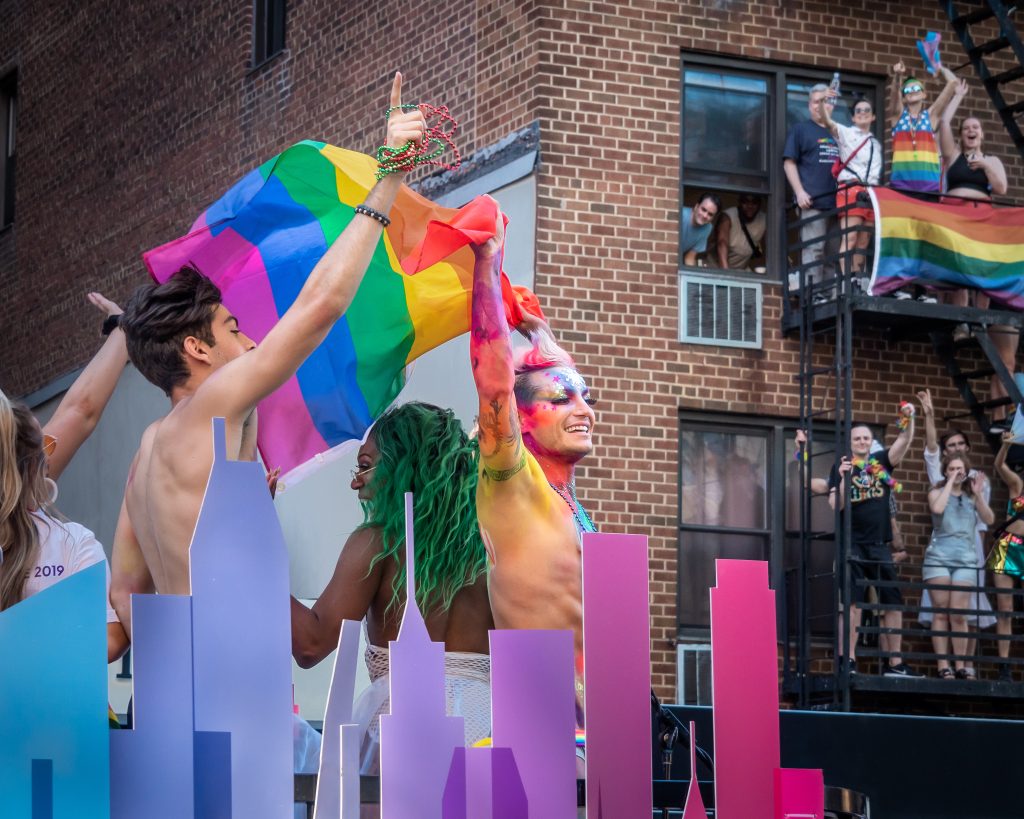
For Jonathan’s Circle, Pride Month sits at the heart of our annual calendar. JC has gay members in significant numbers; we also have bisexual, straight, and questioning members. Pride is the month in which our community’s queer history is most visibly named, and the Circle holds it as a celebration that belongs to everyone who participates in or supports the work.
History
The proximate event behind Pride is the Stonewall uprising of June 28, 1969 — the night patrons at the Stonewall Inn in Greenwich Village resisted a routine police raid. The resistance was led by trans women, drag queens, butch lesbians, and homeless young people, and continued in the streets for several nights. Stonewall was not the first such resistance (Cooper Donuts in LA in 1959, Compton’s Cafeteria in San Francisco in 1966), but it received unprecedented press coverage and became the symbolic founding moment of the modern American gay rights movement.
The first anniversary observance on June 28, 1970, took the form of marches in New York, Los Angeles, Chicago, and San Francisco. The New York march — Christopher Street Liberation Day — drew an estimated five thousand people and is widely considered the first Pride parade. By the 1990s, the month-long expansion had been widely adopted and Pride had become a major civic event.
The 1980s and early 1990s gave Pride its deeper gravity. The AIDS crisis fundamentally reshaped what the month meant: memorial walls of names, ACT UP and other activists using Pride as a platform for political demands, the community’s ability to mourn and celebrate simultaneously. The 2010s saw substantial legal shifts — the repeal of Don’t Ask, Don’t Tell (2011), the Obergefell decision (2015). The 2020s have brought a more complicated landscape: escalating attacks on transgender rights, book bans, and broader cultural backlash. Pride in 2026 is, in many cities, simultaneously more openly celebratory and more openly political than it was a decade ago.
Observances
Pride parades are the most visible feature of the month, typically held in late June in most American cities. The format ranges from enormous all-day events in New York, Los Angeles, San Francisco, and Chicago to modest single-block marches in smaller towns where visibility itself remains an achievement.
Religious observances are widespread. The Metropolitan Community Church (founded 1968), mainline Protestant denominations with affirming theology, Reform and Reconstructionist and most Conservative Jewish communities, affirming Catholic parishes, gay-affirming Buddhist sanghas, and various Muslim and Hindu LGBTQ+ communities all hold Pride services.
Memorial observances are part of nearly every Pride event — reading the names of those lost to AIDS, memorials for victims of anti-LGBTQ+ violence, moments of silence for trans women murdered in the past year. Educational programs, family Pride events, and the proliferation of community flags (the Progress Pride flag designed by Daniel Quasar in 2018 most prominently) are now standard features of the month.
Male Perspective
Pride Month has a particular complexity for Jonathan’s Circle. JC is a men’s organization with significant gay membership and significant non-gay membership, and Pride is one of the months in which that distinction is most visibly held. The Circle honors Pride as one of our most important annual observances, and we hold it as a Circle of mixed orientation and varied background.
For gay Circle members, Pride is yours in a way it is not the same for other men. The history Pride commemorates is, in significant measure, the gay community’s history — the dead, the activists, the legal battles, the cultural shifts. Many Circle members carry personal memory that goes back decades: the men from Pride parades of the late 1970s and 1980s, the friends and partners lost to AIDS who would have been at Pride this year. That history belongs to gay Circle members in a particular way.
For bisexual Circle members, Pride has historically been more complicated than the celebratory narrative sometimes acknowledges — the longstanding pressure to choose a side, the period of invisibility within both straight and gay communities. Pride’s explicit inclusion of bisexual identity is a real and recent achievement. For straight Circle members, Pride is also genuinely yours as the ally, the friend, the brother, the father whose presence at Pride events makes them safer. For questioning members, Pride can be the month in which the questioning becomes more navigable.
A practical observance: attend at least one Pride event in your community, whatever your orientation. A parade, a religious service, a film screening, a moment at a local library’s Pride display. Wear something with the rainbow. If you are partnered, attend together. The visibility itself is the point.
Summary
Pride Month is the annual season in which the community names its dead, celebrates its living, and refuses the silence into which previous generations were forced. The Circle holds it as celebration, memorial, and continuing political fact. Show up.