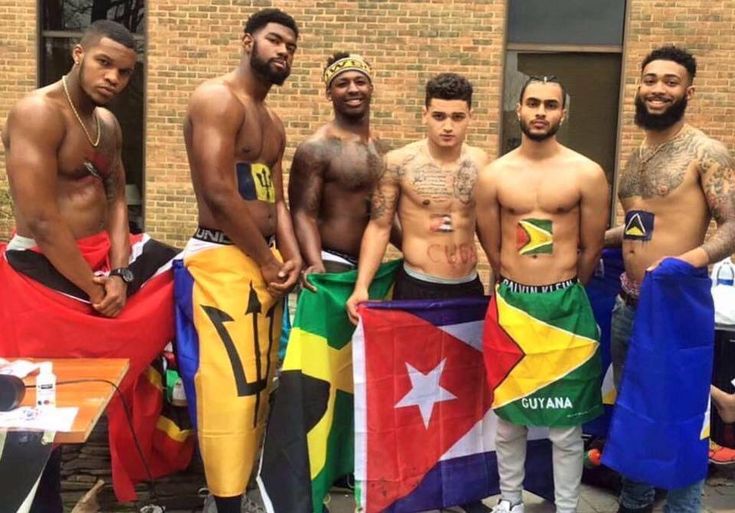
The community is enormously diverse: English-speaking Caribbean Americans (Jamaica, Trinidad, Barbados, Guyana, the Bahamas), Spanish-speaking (Cuba, Dominican Republic, Puerto Rico), French and Creole-speaking (Haiti, Martinique), and Dutch-speaking (Aruba, Curaçao, Suriname). The community spans the full racial spectrum, includes substantial Indo-Caribbean populations, and carries within it the full religious and cultural complexity of one of the most internally varied diasporic communities in American life.
For Jonathan’s Circle, Caribbean American Heritage Month is one of the months in which our commitment to honoring the full diversity of our membership is most directly tested. Caribbean American men have been part of JC throughout our history, and their experiences — including the particular experiences of gay Caribbean American men navigating both family of origin and broader American gay community — deserve the full weight of attention the month invites.
History
Caribbean migration to the United States has multiple distinct streams. The first significant wave in the late nineteenth and early twentieth centuries brought Anglo-Caribbean migrants — particularly Jamaicans — to the eastern United States, where they became important contributors to the Harlem Renaissance and to early Black American political organizing. Marcus Garvey, who founded the Universal Negro Improvement Association in Jamaica before relocating to Harlem in 1916, is the most significant figure from this generation.
The Cuban migration following the 1959 revolution brought hundreds of thousands of Cubans across several waves. The 1965 Immigration Act, ending the racially restrictive national-origins quota system, opened the door to expanded Caribbean migration: large numbers of Dominicans, Haitians, Jamaicans, Trinidadians, and Guyanese transformed the demographic composition of New York, South Florida, and other major metropolitan areas. Puerto Rican migration, occurring under the unique circumstance of citizenship since 1917, has been continuous throughout the twentieth and twenty-first centuries.
The federal Caribbean American Heritage Month observance was established through legislation championed by Congresswoman Barbara Lee, signed into law in 2005, with the first formal presidential proclamation issued in 2006. The month has been observed annually since.
Observances
Cultural events proliferate during the month in cities with substantial Caribbean American populations: Carnival celebrations featuring the distinctive music, costume, and dance traditions of Trinidad; Brooklyn’s West Indian American Day Parade (held on Labor Day but rooted in the same tradition); the Miami Carnival and similar events.
Literary and cultural programming features Caribbean American writers — Edwidge Danticat (Haitian American), Junot Díaz (Dominican American), Jamaica Kincaid (Antiguan American), Audre Lorde, Paule Marshall, Achy Obejas. Religious observances reflect the diversity of Caribbean religious life: Pentecostal, Catholic, Episcopal, Methodist, Seventh-day Adventist congregations, alongside Hindu temples in Indo-Caribbean communities and the substantial population practicing Santería, Vodou, and Espiritismo.
Food is central to most community celebrations: jerk chicken from Jamaica, mofongo from Puerto Rico, ropa vieja from Cuba, mangu from the Dominican Republic, griot from Haiti, doubles and roti from Trinidad, pepperpot from Guyana, and many others.
Male Perspective
Caribbean American Circle members carry experiences the broader American conversation often does not fully see. The pressure to assimilate into broader American racial and ethnic categories — to be received as “African American” rather than as a Jamaican American or Haitian American with distinct traditions, or as “Latino” rather than as a Cuban American or Dominican American with distinct national experiences — is real and shapes how Caribbean American men understand themselves.
For gay Caribbean American men, the negotiation between cultures of origin and the broader American gay community can be complex. The influence of Pentecostal and Catholic Christianity, the cultural ideology of machismo in some traditions, and the historical legacy of British colonial-era anti-sodomy laws still on the books in some Caribbean nations have made openly gay life more difficult in many Caribbean cultural contexts. Many gay Caribbean American men of the older generation lived in significant concealment from family; many of the younger generation continue navigating dual lives. This is not the only configuration, but it is a recurring one.
For straight Caribbean American Circle members, the month invites reflection on the cultural inheritance you carry: traditions of male friendship, of cross-generational mentoring, of the rhythms of music and food and language that hold families together across geographic dispersion. For Indo-Caribbean members, the experience is distinct again, holding South Asian ancestry, Caribbean cultural formation, and American immigrant experience together.
A practical observance: read at least one book by a Caribbean American author during June — Danticat’s Brother, I’m Dying, Díaz’s The Brief Wondrous Life of Oscar Wao, Kincaid’s A Small Place, or Lorde’s Zami. Listen to music. Attend an event if one is accessible. The month is asking attention. Direct it.
Summary
Caribbean American Heritage Month honors a community whose contributions to American life are enormous and whose distinct national, religious, and cultural identities are often folded into broader categories that do not see them. The month asks attention to the particular.