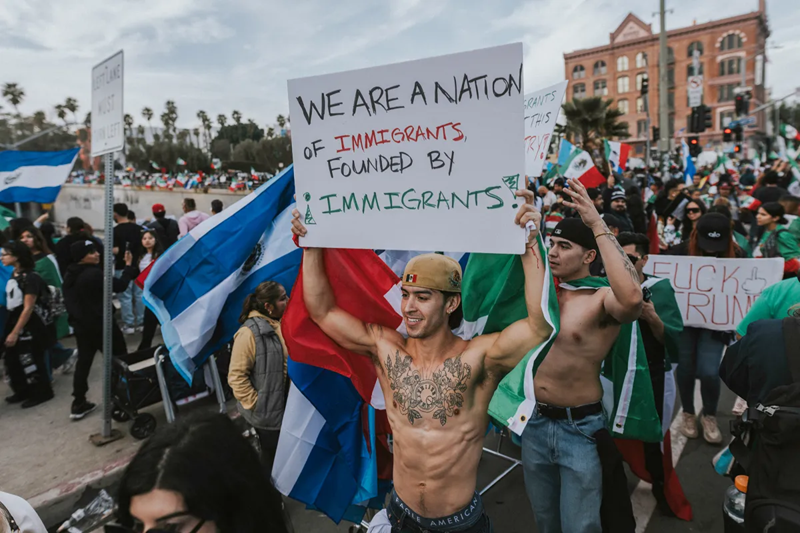
The premise is straightforward: the United States is a nation substantially built by immigrants, the country’s ongoing renewal depends on immigration, and the contributions immigrants make to American economic, cultural, civic, and spiritual life deserve annual recognition. The reality in 2026 is that this premise is more contested in American public life than at almost any point in the past century. The escalation of anti-immigrant policy, rhetoric, and enforcement has made Immigrant Heritage Month both more emotionally weighted and more politically necessary than its founders may have anticipated.
For Jonathan’s Circle, the month carries particular weight. The Circle has immigrant members in significant numbers — men born in other countries who have made their lives here, men whose parents or grandparents immigrated, men whose families have been in the United States for generations but still carry the immigrant inheritance. The Circle also has members from refugee backgrounds and members whose own coming-out journeys included immigration to places where openly gay life was possible.
History
American immigration history is the broader history within which the month sits. The colonial-era European migrations alongside the forced migration of enslaved Africans established the country’s initial demographic base. The mid-nineteenth-century Irish and German migrations brought millions of Catholic immigrants whose arrival sparked significant nativist political reaction. The late-nineteenth and early-twentieth-century migrations from Southern and Eastern Europe — Italians, Greeks, Poles, Russian Jews — again provoked nativist legislation, culminating in the 1924 Immigration Act’s racially restrictive quota system.
The 1965 Immigration and Nationality Act fundamentally reshaped American immigration, ending the national-origins quota system and opening the country to substantial immigration from Asia, Latin America, the Caribbean, and Africa. By 2020, foreign-born Americans constituted approximately fourteen percent of the population, comparable to the early-twentieth-century peaks.
The immigration of LGBTQ+ people has its own particular history. U.S. immigration law explicitly excluded homosexual immigrants until the 1990 Immigration Act removed the homosexuality exclusion. The 2013 Windsor decision allowed recognition of same-sex marriages for immigration purposes, and the 2015 Obergefell decision established nationwide marriage equality. The 2020s have brought a particularly intense period for American immigration politics, with substantial expansion of enforcement and reductions in legal pathways making Immigrant Heritage Month observances more politically charged than they have been in recent memory.
Observances
Public celebrations of immigrant contributions form the central observance of the month — cities across the country host events featuring immigrant communities through food festivals, music and dance performances, literary readings, and educational programs. The diversity reflects the diversity of immigration itself: Vietnamese American festivals in California, Somali American observances in Minneapolis, Mexican American celebrations across the Southwest, West African celebrations in New York.
Religious observances take many forms across Christian, Jewish, Muslim, Hindu, Buddhist, and other religious communities with substantial immigrant memberships. Educational programming at libraries, schools, museums, and community organizations expands during the month. Direct service organizations use the month for fundraising, volunteer recruitment, and political advocacy.
Solidarity events organized by non-immigrant Americans have become significant in recent years — faith communities and civic organizations holding vigils, rallies, and public statements of support, particularly in communities where immigrant residents have faced threats. Personal and family observances — family meals featuring foods of origin, conversations across generations about immigration stories — are quieter but represent much of what the month actually means in immigrant households.
Male Perspective
For immigrant Circle members, this is your month, and the Circle holds you in particular gratitude for the work you have done to make your American lives. The decision to leave one country for another — whether for economic opportunity, political safety, family reunification, education, or the search for a more livable life — is one of the most consequential decisions any person makes. The work of becoming American while remaining yourself, of holding two homes in your mind at once and giving each its due, is real work.
For gay immigrant Circle members in particular, the journey has often included an additional dimension. Some gay men have immigrated specifically because openly gay life was impossible in their countries of origin. The asylum process for LGBTQ+ claimants is particularly demanding, requiring claimants to document persecution that often occurred in private. The community of LGBTQ+ refugees and asylees in American cities is real and important, with its own organizations and ongoing work.
For Circle members descended from immigrants of earlier generations — the children and grandchildren of Italian, Irish, German, Polish, Jewish, Chinese, Mexican immigrants — the month invites you to remember your family’s story honestly. Many of the same nativist arguments deployed against Italian or Irish or Jewish immigrants a century ago are being deployed against Latin American and Asian and African immigrants today. The historical perspective is part of what the month offers.
For non-immigrant Circle members in 2026, ordinary celebration of immigrant contributions is not, by itself, sufficient. The question of public solidarity — supporting refugee resettlement, providing legal assistance funding, contacting elected officials about specific policies, being publicly visible in support of immigrant neighbors — is one each member can consider for himself. A practical action: donate to an immigrant legal aid or refugee resettlement organization, read at least one book by an immigrant author, attend a public Immigrant Heritage Month event in your community, or call an elected official about an immigration policy you care about.
Summary
Immigrant Heritage Month honors the contributions of immigrants to American life and, in 2026, has become a site of more direct political weight than its founders may have anticipated. The Circle holds its immigrant members in particular gratitude and holds the broader question of public solidarity as work the moment requires.