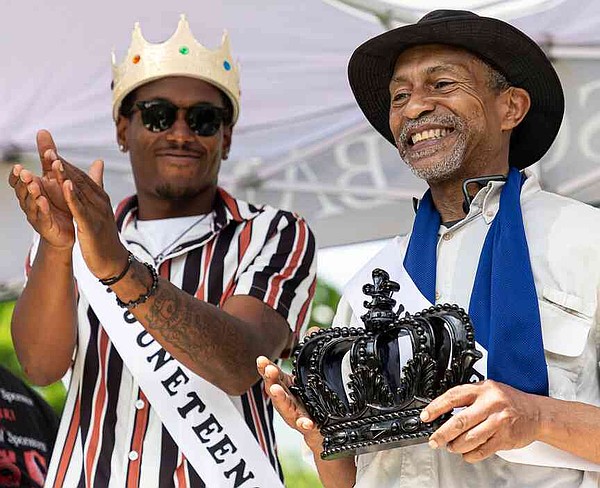
For Jonathan’s Circle, Juneteenth is one of the most important days of the year. JC has Black members in significant numbers, and the Circle has shown up for Black liberation observances throughout our institutional history. The day is also an opportunity for all Circle members, of every background, to take honest measure of the country we live in — whose foundational sin of slavery remains the deepest fact of American history and whose continuing work toward racial justice has been the central moral struggle of our national life.
History
On June 19, 1865, Union Major General Gordon Granger arrived in Galveston, Texas — the last major Confederate-held area — and issued General Order No. 3, which informed the enslaved people of Texas that they were free. The announcement was technically late: the Emancipation Proclamation had been issued on January 1, 1863, and the Confederate surrender had occurred on April 9, 1865. But Texas had been geographically distant from Union forces throughout the war, meaning that the practical end of slavery in Texas came more than two years after its legal end.
The first Juneteenth observances took place in Texas in 1866, organized by formerly enslaved people. As Texas Black communities spread across the country in subsequent decades — particularly during the Great Migration — they brought Juneteenth observances to new regions. The Texas state legislature made Juneteenth an official state holiday in 1980, the first state to do so. Other states followed across subsequent decades.
The federal designation came in 2021 through the Juneteenth National Independence Day Act, signed by President Biden on June 17, 2021. The federal designation followed the racial justice reckoning of 2020 in the aftermath of George Floyd’s murder. The cultural expansion since federal designation has been substantial, with both expanded public observance and ongoing conversations within the Black community about authentic observance versus corporate co-optation.
Observances
Family and community gatherings are the central traditional observance. The historic pattern — going back to the early Texas observances — involves outdoor cookouts and barbecues, music and dancing, the wearing of red (associated with the blood spilled in the freedom struggle), and traditional foods including red drinks (hibiscus tea, red soda), barbecue, and dishes drawn from Black Southern culinary traditions.
Religious observances are widespread in Black congregations: AME, AME Zion, CME, Black Baptist, Black Pentecostal, and other historically Black denominations hold Juneteenth services. Public events have expanded substantially: parades, festivals, and concerts in cities across the country, particularly those with substantial Black populations (Atlanta, Houston, Detroit, Chicago, Washington D.C.).
Memorial observances honor the dead — those who did not survive the Middle Passage, those who did not survive American slavery, the lynching victims of the post-Reconstruction era, and the victims of contemporary racist violence. The Equal Justice Initiative’s National Memorial for Peace and Justice in Montgomery has become a significant site of pilgrimage. Political advocacy events often coincide with the holiday, with civil rights organizations using the visibility to advance contemporary priorities.
Male Perspective
For Black Circle members, Juneteenth is your holiday, and the Circle holds it with the gratitude that comes from recognizing the specific historical inheritance the day commemorates. The work your ancestors did to survive slavery, to build communities after emancipation, to navigate the long Jim Crow era, to organize the civil rights movement, and to continue the work of full citizenship through every subsequent generation — this is the work that made it possible for any Black American to be present today as a free citizen.
For Black gay Circle members, the day has additional layers. The Black gay political tradition — from Bayard Rustin (the architect of the 1963 March on Washington) through James Baldwin, Audre Lorde, Marsha P. Johnson, Essex Hemphill, and the continuing tradition into the present — has made enormous contributions to both Black freedom and gay liberation. Juneteenth is a natural occasion to honor this tradition.
For other Circle members of color — Latino, Asian, Indigenous, Caribbean — Juneteenth is an opportunity for solidarity rather than appropriation. The day belongs primarily to Black Americans; non-Black members of color participate as allies whose own communities’ histories are part of a broader struggle for which Black liberation has often been the leading edge. For white Circle members, Juneteenth requires a particular kind of attention. The holiday is not for the comfortable celebration of an emancipation that white Americans, as a group, did not bring about but that was won by Black people through centuries of survival and decades of organized struggle. The honest white Juneteenth observance involves listening more than speaking and contributing to Black-led organizations.
There is also the present-tense gravity of the moment. The level of racial backlash visible in American politics across the past several years — the rollback of voting rights protections, the assault on Black-affirming education, the resistance to even modest racial justice initiatives — makes the day’s meaning more urgent than it was in the immediate post-2021 honeymoon. A practical observance: read the Galveston General Order No. 3 aloud, even alone, on June 19. Attend a Juneteenth event organized by a Black-led organization. Make a donation to a Black-led organization doing work you respect.
Summary
Juneteenth commemorates the announcement of emancipation in Galveston, Texas, on June 19, 1865, and honors the continuing Black American work toward full freedom. The day asks honest engagement with American history and present-tense participation in the freedom struggle that remains unfinished.