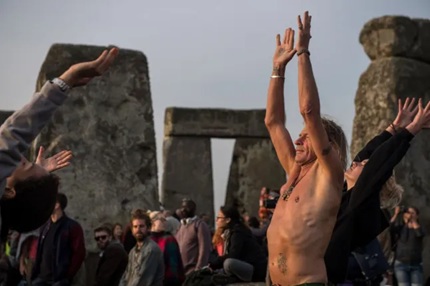
In Pagan and Wiccan traditions of the Northern Hemisphere, the summer solstice is known as Litha or Midsummer, one of the eight sabbats of the Wheel of the Year and one of the four solar holidays. In broader Western cultural tradition, Midsummer has been observed for many centuries as a folk festival marking the height of summer, with particularly strong continuing traditions in Scandinavian countries.
For Jonathan’s Circle, the summer solstice completes the seasonal quartet of equinoxes and solstices that anchor the broader calendar of celebration pages. The day is one of the most universally accessible spiritual observances of the year — requiring no doctrinal commitment, happening in the sky regardless of any human belief, and available to any Circle member who wishes to mark the moment.
History
Astronomical observation of the summer solstice is one of the oldest documented practices of human cultures. The architectural alignments at Stonehenge in England, where the rising sun on the summer solstice is framed by the Heel Stone, demonstrate that Neolithic British cultures were tracking the solstice more than five thousand years ago. Similar alignments exist at sites across the world: the Bighorn Medicine Wheel in Wyoming, various Mesoamerican sites, ancient Egyptian temples, Chinese imperial observatories.
In Northern European folk tradition, Midsummer was one of the most beloved holidays of the year. The Scandinavian Midsummer (Midsommar in Swedish, Juhannus in Finnish, Sankt Hans in Danish and Norwegian) remains today one of the central holidays of the Nordic calendar. Traditional observances include the raising of the Midsummer pole, dancing in circles, the gathering of flowers and herbs, and the all-night celebrations that the near-perpetual daylight of the high northern latitudes makes possible.
The Christian tradition incorporated some Midsummer customs into the feast of Saint John the Baptist (June 24). In the modern Wiccan and neopagan tradition, the summer solstice was integrated into the Wheel of the Year structure developed by Gerald Gardner and others in the mid-twentieth century. The name Litha was popularized by Aidan Kelly in 1974, drawing on a name used by the Venerable Bede. The Stonehenge solstice observances are now a substantial public phenomenon, with English Heritage opening the monument to public access on the night of the summer solstice each year, drawing tens of thousands of visitors.
Observances
Litha observances in Wiccan and neopagan traditions typically involve outdoor ritual gatherings centered on the sun and on the year’s peak of solar energy. The lighting of bonfires (or candles where bonfires are impractical), the consumption of seasonal foods, and ritual acknowledgment of the sun’s peak before its slow decline back toward winter are common features.
Scandinavian Midsummer involves elaborate traditional customs: the raising of the Midsummer pole, the dancing of traditional circle dances, the wearing of flower crowns, and the traditional Midsummer meal of new potatoes, pickled herring, and strawberries. Stonehenge gatherings draw tens of thousands of people for sunrise; similar gatherings occur at Newgrange in Ireland, various Mesoamerican sites, and the Bighorn Medicine Wheel.
Secular and personal observances vary widely. Many people simply note the day with attention to the unusually long evening, perhaps with an outdoor meal taking advantage of the late sunset. Astronomical and educational observances at planetariums and observatories often include solstice programming.
Male Perspective
The summer solstice is one of the most universally accessible spiritual observances of the year for any Circle member, of any orientation, ethnicity, religious tradition, or none. The day belongs to no specific religion and is not the property of any particular tradition. It is happening in the sky regardless of any human belief.
The festival’s deepest theme — the year’s peak of light, the moment before the long slow decline back toward darkness — has resonance for any man old enough to have lived through some seasons. The summer solstice is, paradoxically, the moment at which the days begin getting shorter again. The light has reached its maximum and now begins, almost imperceptibly at first, to retreat. The peak is also the turning point.
For Circle members who have lived long enough to be aware of their own mid-life or later-life situation, the solstice can have particular emotional resonance. The peak of one’s own physical or professional power may have passed or be passing, and the question of how to live well in the long slow turning toward the dark is one of the central questions of an adult life. For younger Circle members, the solstice has different resonance: the long expansion of opportunity is still unfolding, and the day can be a quiet reminder to receive the present moment fully.
A practical observance: on the evening of June 20 or 21, spend at least an hour outside in the late evening. Take advantage of the unusually long evening light to do something outdoors that you usually do indoors — eat a meal, read a book, have a conversation. Notice the moment when the light finally begins to fade. At sunset on the solstice itself, pause for a moment of attention. Acknowledge what has been good in the first half of the year. Note what you want to attend to in the second half. The half-year point that the solstice represents is a natural occasion for reflection.
Summary
The Summer Solstice is the longest day of the year and the moment the light begins, slowly and certainly, to retreat. The festival is older than any doctrine about it. The instruction is to be present in the fullness before the long turning begins.