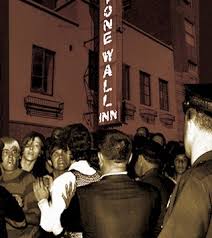
For Jonathan’s Circle, the Stonewall Anniversary is one of the most directly important days of the year. The uprising was led by the most marginalized members of what was then called the homophile community — trans women, drag queens, butch lesbians, hustlers, homeless young people — and the legacy belongs to every Circle member whose ability to live openly in 2026 was made possible by what flowed from those few summer nights in 1969.
History
The Stonewall Inn in June 1969 was a Mafia-owned bar serving a clientele diverse by the standards of the late-1960s gay world: gay men of various races and ages, lesbians, trans women, drag queens, and the homeless street youth (including significant numbers of Black and Latino young people) who had few other places to gather.
The raid on the night of June 27-28, 1969, was conducted by officers from the NYPD’s Public Morals Division. Police raids on gay establishments were routine in that period. What made this night different is contested, but the widely accepted account is that the patrons present, particularly the trans women, drag queens, and butch lesbians who bore the most direct brunt of the raid’s violence, declined to follow the usual pattern of submission. The crowd outside grew, a particular incident sparked broader resistance, and the resistance continued for several nights.
Several specific historical figures are central to Stonewall’s memory. Marsha P. Johnson, a Black trans woman who was a regular at the bar, was one of the central early resisters and would co-found Street Transvestite Action Revolutionaries (STAR) with Sylvia Rivera, a Latina trans woman also present at Stonewall. Stormi DeLarverie, a Black butch lesbian, has been variously credited with sparking the resistance. The first anniversary observance on June 28, 1970 — Christopher Street Liberation Day in New York, with companion marches in LA, Chicago, and San Francisco — established the tradition of June Pride observances that has continued for fifty-six years.
Observances
The major Pride parades in cities across the United States and around the world are typically held on or near the Stonewall Anniversary, with the most direct ceremonial commemoration usually at the Stonewall Inn itself in New York City. Wreath-laying and commemorative events at the Stonewall National Monument have become an annual tradition.
Religious observances marking the anniversary are widespread. Many LGBTQ+-affirming congregations hold Stonewall Sunday services on the Sunday nearest June 28, with liturgical readings and prayers that explicitly connect religious community to the broader history of LGBTQ+ liberation. The Metropolitan Community Church, founded the year before Stonewall, has particular reason to mark the day.
Personal pilgrimage to the Stonewall Inn is a tradition for many LGBTQ+ people. Educational programming — film screenings, panel discussions, reading programs — expands public engagement with the history. Political advocacy events often coincide, with the political legacy of Stonewall invoked by contemporary advocates working on trans rights, marriage equality, anti-discrimination protections, and other ongoing concerns.
Male Perspective
For older Circle members — men in their late sixties, seventies, and eighties — the Stonewall Anniversary carries personal historical weight younger members cannot directly remember. These are men who came of age in the immediate post-Stonewall years, who built the institutions of the 1970s gay liberation movement, who lived through the AIDS crisis as adults. The first wave of openly gay institutions — community centers, newspapers, religious congregations, the early gay neighborhoods of major cities — were built by this generation.
For middle-aged Circle members, the anniversary is the inherited history of their formative years — the men who came of age during the height of the AIDS crisis, watched friends and partners die in disproportionate numbers, built the second-generation gay institutions, and participated in the political battles that led to marriage equality. For younger Circle members, Stonewall is the foundational history of a world they entered already substantially transformed. The work of preserving and extending the gains of previous generations now falls particularly on them.
For the trans members of our broader community whose history is most directly central to Stonewall, the anniversary has carried particular weight in recent years. The early popular narrative sometimes downplayed the central role of trans women and drag queens; the corrected historical record has rightly centered Marsha P. Johnson, Sylvia Rivera, and others. The contemporary backlash against trans rights has made the anniversary’s emphasis on trans leadership at the movement’s founding particularly important.
For straight Circle members, the anniversary is part of the larger history of American freedom you also inherit. The freedom of straight men to be present in a Circle of mixed orientation, to have gay sons and brothers and friends fully part of family and community life — these freedoms are products of the same movement that began at Stonewall. A practical observance: read the names of Marsha P. Johnson, Sylvia Rivera, and Stormi DeLarverie aloud, even alone, on June 28. Visit the Stonewall National Monument if you are in New York City. Watch a documentary (Happy Birthday Marsha or Stonewall Uprising) or read David Carter’s Stonewall: The Riots That Sparked the Gay Revolution.
Summary
The Stonewall Anniversary marks the night in June 1969 when the most marginalized members of the homophile community — trans women, drag queens, butch lesbians, hustlers, homeless young people — refused to follow the usual pattern of submission to a police raid. Every Circle member of every orientation inherits some piece of what their refusal made possible.