
- Pentecost
Overview
Pentecost, observed in 2026 on Sunday, May 24, is one of the principal feasts of the Christian liturgical year. It commemorates the descent of the Holy Spirit upon the gathered disciples of Jesus, fifty days after his resurrection and ten days after his Ascension. The word Pentecost comes from the Greek pentēkostē, meaning fiftieth, and the day takes its name from the original Jewish festival of Shavuot — also called the Feast of Weeks — which falls fifty days after Passover and which the disciples were observing in Jerusalem at the moment the Spirit arrived.
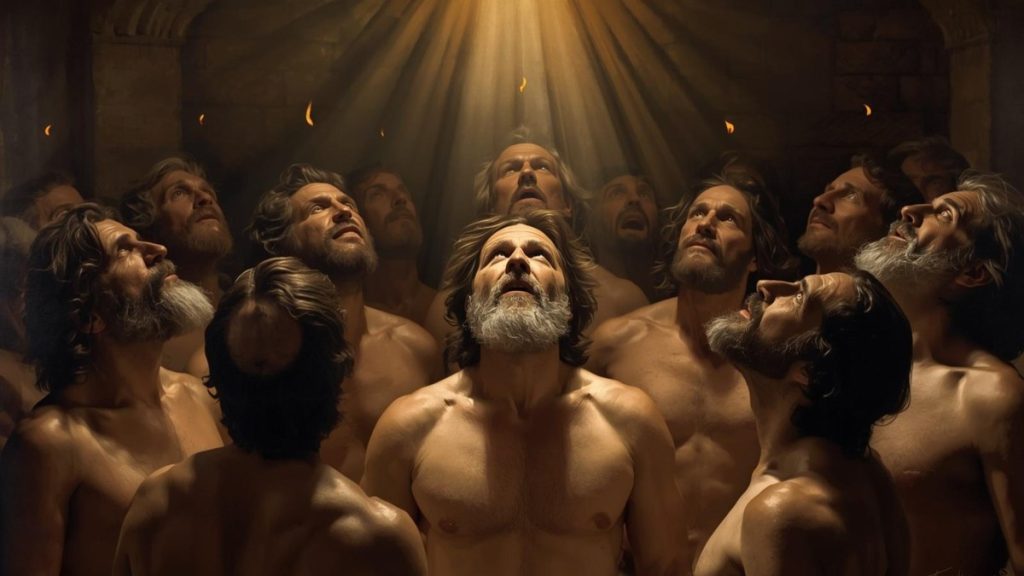
For Christians, Pentecost is often called the birthday of the Church. The day marks the moment when the disciples, until then a small frightened group hiding in an upper room, received the courage and gifts of the Spirit and went out into the streets of Jerusalem to begin the public preaching that would, over centuries, become a worldwide religion. Liturgically, Pentecost closes the fifty-day Easter season and inaugurates Ordinary Time.
For gay men, Pentecost has a particular relevance that is not always preached but that the text itself almost insists upon. The Spirit’s gift, in the original account, is the gift of being heard — each person hearing the disciples speak in their own language. The day is, among other things, a feast of being understood across difference.
History
Pentecost’s biblical narrative is found in Acts 2. Fifty days after Passover — the festival during which Jesus had been crucified — the disciples were gathered together in Jerusalem for Shavuot. A sound like a violent wind filled the house. Tongues of fire appeared and rested on each of them. They were filled with the Holy Spirit and began to speak in other languages. Jews from across the Mediterranean and the Near East, in Jerusalem for the festival, heard them — each in his own native language. Peter then preached the first public sermon of the Christian era, and the text records that three thousand people were baptized that day.
The festival’s Jewish ancestor, Shavuot, has its own ancient story. The fiftieth day after Passover, in Jewish tradition, is the day God gave the Torah to Moses on Mount Sinai. The new covenant of Sinai — the law that constituted Israel as a people — was made on the same day on which, in the Christian narrative, the new covenant of the Spirit was sealed in the disciples. The two festivals stand in deliberate counterpoint, and many Christian theological treatments of Pentecost work with that counterpoint explicitly: where Sinai gave the law written on stone, Pentecost gave the Spirit written on hearts; where Sinai gathered Israel, Pentecost gathered the nations.
The Christian feast was observed from the earliest centuries. By the second century it was already a fixed liturgical celebration, and by the fourth century the fifty-day Easter season was structured to lead toward it. The medieval Western Church developed extensive Pentecost customs — red vestments to symbolize the tongues of fire, the singing of Veni Creator Spiritus, the release of doves in some cathedrals to symbolize the Spirit’s descent, sometimes the showering of rose petals from the church ceiling.
In England, Pentecost was traditionally called Whitsunday — White Sunday — from the white garments worn by candidates for baptism on the day. Whitsunday was a significant English public holiday for centuries, with church ales, processions, and folk celebrations. The Whitsun Walks and other customs survived in some form into the twentieth century. The Reformation, particularly its Reformed and Puritan forms, complicated the inheritance, but the day has retained its place in the Christian year.
In contemporary Christianity, Pentecost has had a particular flowering in the global Pentecostal and charismatic movements that began in the early twentieth century at the Azusa Street Revival in Los Angeles in 1906. These traditions, now numbering hundreds of millions of adherents worldwide, take the Acts 2 account as the central paradigm of Christian experience: the present-tense filling of the Spirit, the speaking in tongues, the gifts of healing and prophecy. The mainstream Catholic and Protestant traditions retain Pentecost as a feast day; the Pentecostal traditions have made it the heart of an entire spirituality.
Observances
In liturgical churches — Catholic, Orthodox, Anglican, Lutheran — Pentecost is observed with particular solemnity. Red vestments are worn, the church may be decorated with red paraments and flowers, and the day’s readings center on the Acts 2 narrative. Many parishes sing Veni Creator Spiritus or Veni Sancte Spiritus in Latin or vernacular translation. In Catholic and Orthodox traditions, the eve of Pentecost is sometimes observed with an extended vigil mirroring the Easter Vigil in structure if not in length.
The Pentecost novena — the nine days of prayer between Ascension Thursday and Pentecost — is the original novena, the prayer practice from which all later novenas took their form. Many Catholics still pray the novena in some form during this stretch. It is a quiet but ancient devotion.
In Pentecostal and charismatic congregations, Pentecost Sunday is often a high point of the year, with extended services that may include speaking in tongues, prophecy, healing services, and the laying on of hands. The atmosphere is intentionally distinct from the more contained liturgical traditions, and the contrast can be illuminating: the same biblical text producing very different forms of observance.
In Eastern Orthodox tradition, Pentecost is observed with a particular custom: the Kneeling Prayers of Pentecost, the first prayers said while kneeling since Easter began. The Easter season has been a season of standing as a sign of resurrection; Pentecost reintroduces kneeling, marking the return to ordinary time and ordinary postures of devotion.
For those without a church community, Pentecost can be marked privately by reading the Acts 2 narrative, by walking outdoors and feeling the wind, by lighting a candle and holding silence, by inviting a few people to share a meal in honor of the day. The image of fire and of unexpected understanding across difference can frame the gathering in any number of useful ways.
Male Perspective
Pentecost has a particular charge for Circle members in the Christian tradition because the day’s central miracle is the miracle of being understood. The disciples speak; people from many nations hear them — each in his own language. The Spirit, in the Acts narrative, does not erase difference. It bridges difference. Each person hears the message in the tongue he was born to.
For Circle members who have spent long stretches not being heard — in churches that could not understand them, in families that would not, in their own struggles to find language for their own experience — the Pentecost narrative is a quietly radical promise. The Spirit is not the force that requires us to translate ourselves into a language not our own. The Spirit is the force that lets each of us be heard in the tongue we actually speak. That is a different kind of grace, and it is one that gay men in the Circle have particular reason to receive — but they are not the only ones. Any man who has spent years inside churches or families or workplaces where the truth of who he was could not be plainly spoken knows what the disciples’ hearers heard.
There is also a deeper reading available. The disciples in the upper room, before Pentecost, are afraid. They are hiding behind locked doors. They have lost their teacher; they do not yet know what they are. The Spirit’s arrival is not gentle — wind, fire, the bursting of the doors, the impulse to go out into the public square. Pentecost is the day they stop hiding. For any man whose faith has been an interior practice held in fear of one kind or another, the Pentecost narrative has things to say about what eventually happens when the Spirit is genuinely received: the closed door, sooner or later, opens.
For Circle members in the post-Christian or non-Christian segments of our community, Pentecost can still be received as a useful image. Every man’s life has its closed-room periods — the seasons when one has lost direction, when fear has won, when the next move is not visible. Pentecost names the experience of the next move arriving as a gift rather than a strategy: the wind that comes from outside, the fire that lights without being summoned, the moment when one finds oneself speaking in front of strangers in language one did not know one had. The day honors the possibility of unexpected courage. Most men, given long enough lives, eventually receive at least one such moment.
A simple practice for the day: read Acts 2 aloud, even alone. Pay particular attention to the list of nations — Parthians, Medes, Elamites, Mesopotamians, Cretans, Arabs, Romans — each hearing the message in his own language. Sit with the question of whose language the Spirit might still be teaching you to hear, and whose language you might still be learning to speak so that someone else can finally hear you.
Summary
Pentecost is the feast of holy disruption — the moment when everything locked opens, everything silent speaks, and everything scattered finds a center.
Date: May 24, 2026 (50 days after Easter)