
- Beltane
Overview
Beltane is one of the four great fire festivals of the Celtic year, celebrated on May 1 in the Northern Hemisphere and on November 1 in the Southern. It marks the beginning of summer and the season of fertility, growth, and abundance. Where its winter counterpart Samhain honors the threshold to the dark half of the year, Beltane opens the bright half: the season of light, generation, and outward-pouring life.
History
The earliest written references to Beltane appear in early Irish texts of the ninth and tenth centuries, but the festival itself is much older. Archaeological and folkloric evidence suggests it formed part of a quartered Celtic year along with Imbolc (early February), Lughnasadh (early August), and Samhain (early November) — four cross-quarter days falling halfway between the solstices and equinoxes. These festivals organized the agricultural and pastoral year of pre-Christian Celtic Europe.
In its most documented historical form, Beltane was the day on which cattle were driven out from their winter byres to summer pasture. Two great fires were lit, often on a hilltop, and the herds were driven between them in a ritual of purification and protection against disease and bad luck. Households would extinguish their hearth fires on the eve of Beltane and rekindle them from the great festival fire — a renewal of light from a shared source. The image is striking and characteristic: the community’s flames all coming from one origin, then carried home.
The festival also carried strong erotic and fertility associations. Beltane was a customary night for handfasting — a year-and-a-day trial marriage that could become permanent or be dissolved at the next Beltane. Couples spent the night in the woods or on the heath, and the resulting children were considered children of the May, blessed rather than illegitimate. The maypole, with its phallic central shaft and ribbons danced in alternating directions to form a woven pattern, is the most iconic surviving symbol of these older fertility associations.
With the spread of Christianity, Beltane was partially absorbed into the May feast of the Virgin Mary in some regions and partly suppressed in others. Puritan reformers in seventeenth-century England banned maypoles outright as pagan idolatry, and many traditional practices went underground or disappeared. The nineteenth and twentieth centuries saw a folkloric and then Pagan revival that has continued to the present, with the Beltane Fire Festival on Edinburgh’s Calton Hill (begun in 1988) drawing tens of thousands of celebrants annually.
Observances
Modern Beltane observance varies by tradition. In Wiccan and Neo-Pagan circles, the festival is one of the eight sabbats of the Wheel of the Year and is celebrated with rituals that honor the union of the May Queen and the Green Man, the sacred pairing of the goddess and god whose joining brings the world into fertile blossom. Maypole dances, bonfires, and the gathering of May flowers are common.
For those drawn to the festival outside formal Pagan practice, Beltane invites a few simple observances. Build or attend a fire — even a small one in a backyard pit. Gather greenery and flowers and bring them inside; many traditions specifically favor hawthorn (the May tree), which traditionally blooms around Beltane in temperate Europe. Sleep with the windows open if the weather allows. Eat outside. Make love. Walk barefoot on the earth.
In secular Europe and elsewhere, the day survives as May Day with its own civic and political associations — International Workers’ Day, marches, parades, the crowning of May queens in some local festivals. These secular observances often unwittingly preserve Beltane elements: outdoor gathering, festive drinking, public celebration of vitality and the season’s turn.
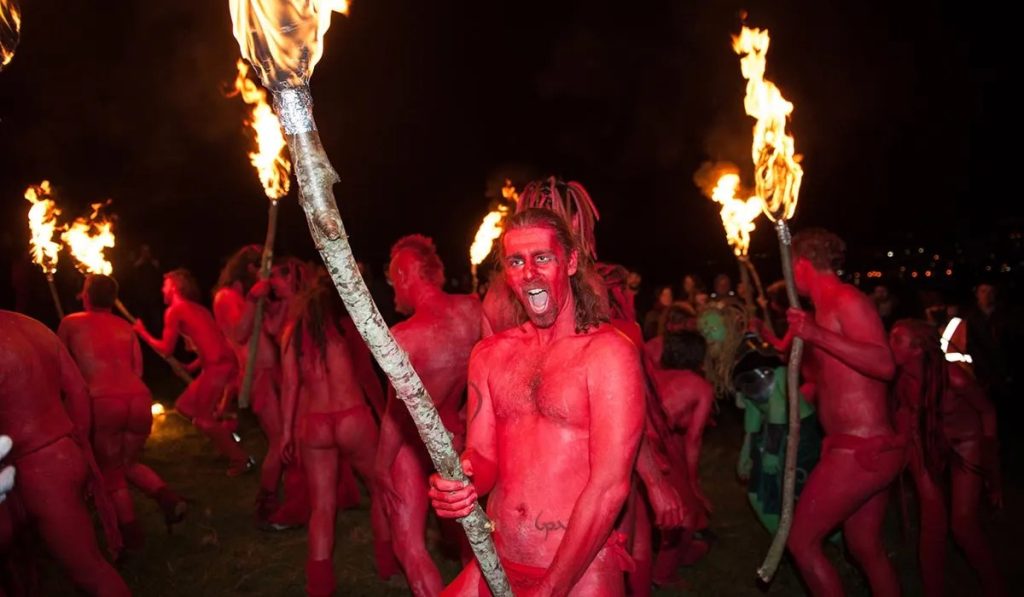
The Edinburgh Beltane Fire Festival, the largest contemporary public observance, includes a procession from Calton Hill led by the May Queen and the Green Man, attended by drummers and elemental performers (red men, blue men, white women, etc.), culminating in the lighting of a great bonfire and the symbolic union of the divine pair.
Male Perspective
For Circle members, Beltane offers an unusual gift among festivals: it makes no apology for desire. The festival’s entire premise is that the world is renewed by the meeting of bodies, by warmth seeking warmth, by sap and seed and skin. Where many spiritual traditions have asked men to discipline or sublimate desire, Beltane treats it as the engine of cosmic renewal. The rising of the sap in the trees and the rising in our own bodies are the same event in different forms.
The festival’s default imagery — the Goddess and the God, the May Queen and the Green Man — is heterosexual and reproductive, and that imagery may resonate strongly for some men in the Circle and feel like a frame that needs translating for others. Either reception is fine; the festival has been received in both ways for as long as it has been observed. The deeper logic of Beltane is not specifically about male-female pairing; it is about the meeting of complementary energies, the moment when restraint releases into expression, the dance of the two-becoming-one. Every man’s desire is at home in that logic, whatever direction it runs. The fertility honored at Beltane includes the fertility of friendship, of art, of community, of the deep care between men that fathers what could never be fathered any other way — and, for the men whose lives include them, the fertility of biological children, marriage partners, families of origin and choice.
For Circle members, Beltane is a natural occasion for the kind of work StoneSong pursues at scale: the gathering of men, fire, embodiment, ritual, the affirmation that pleasure and the sacred are not opposed. The festival is older than the doctrines that put them in opposition. Returning to it can feel less like adopting a foreign tradition than like remembering something the body already knows.
Practical suggestion for solo or small-group observance, available to any man whatever his configuration of partner, family, or community: on Beltane eve, build a fire if you can. Take off your shirt. Stand close enough to feel its heat. Speak aloud the names of what you are grateful to your body for — the things it has given you, the things it has carried, the pleasures and survivals both. Sleep that night with your skin against another’s, or against the air, or against the grass. The festival doesn’t require partners. It only requires presence.
Summary
Beltane is the great erotic fire at the center of the Celtic year — a festival that refuses to separate the sacred from the sensual, the spiritual from the embodied.
Date: May 1