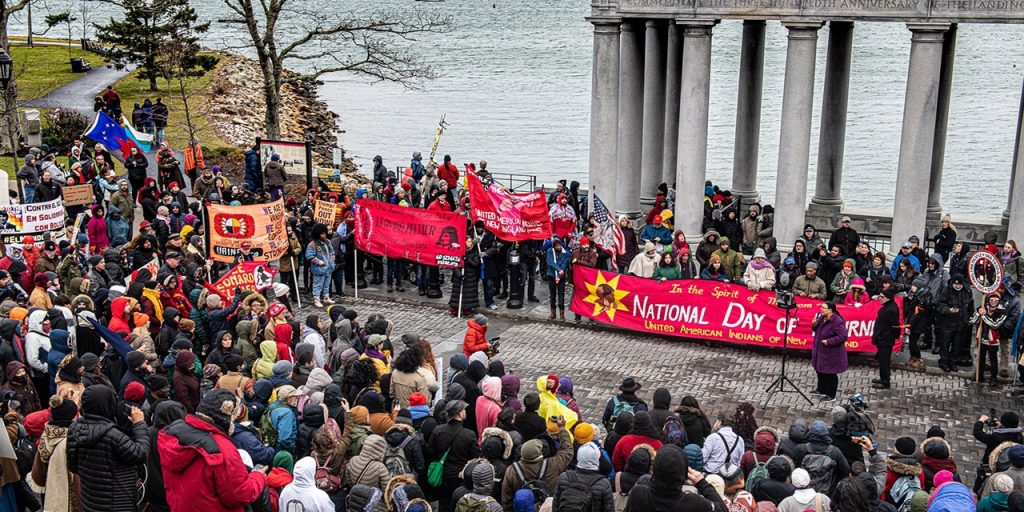
The day is not an alternative to Thanksgiving so much as a correction to it. Where the standard national story of Thanksgiving describes a peaceful 1621 harvest shared between the Pilgrims and the Wampanoag, the National Day of Mourning tells what came next: the systematic dispossession, displacement, enslavement, and killing of the peoples who were already here. The day is a public act of truth-telling and a gathering of the descendants of those who survived.
For a community whose members know what it feels like to be excluded from the national story — queer people, after all, have our own long experience of being written out of the official history — the National Day of Mourning is an observance that asks for solidarity, listening, and the specific kind of attention that does not try to make itself the center.
History
The observance began in 1970, when the Commonwealth of Massachusetts invited Wamsutta Frank James — a leader of the Aquinnah Wampanoag Tribe, whose ancestors had met the Pilgrims in 1621 — to speak at a state banquet marking the 350th anniversary of the Pilgrims’ arrival.
James submitted his speech in advance, as requested. Organizers found it too confrontational — it named the massacres of his people, the theft of Wampanoag graves, the broken treaties — and told him he could not deliver it unless he agreed to let them substitute a sanitized version. He refused.
Instead, James gathered with other Native people on Cole’s Hill above Plymouth Rock on Thanksgiving Day and gave the speech he had intended to give. He named the gathering the National Day of Mourning. It has been held every Thanksgiving since.
The gathering is organized by United American Indians of New England (UAINE) and draws Native people from across the continent, as well as non-Native supporters. It is a day of fasting, speeches, drumming, and — in many years — a march through the historic district of Plymouth. A plaque now stands on Cole’s Hill, placed there in the 1990s after a long effort, that briefly tells the day’s history and the reasons for its keeping.
Observances
The gathering at Plymouth begins around noon with the ringing of a bell. Speakers address the assembled crowd — Native leaders, youth, elders, and sometimes allies who have been invited by UAINE. The themes return each year: the ongoing presence of Native peoples (not confined to the past), the continuing fight for sovereignty and treaty rights, specific current struggles (missing and murdered Indigenous women and relatives, pipelines through Native land, the recovery of children taken into the federal boarding school system), and the simple refusal to let the false story of a peaceful origin stand uncontested.
For those who cannot be in Plymouth, the day can be marked by fasting (many observe the full day in solidarity), by reading Wamsutta Frank James’s original 1970 speech (widely available online), by donating to UAINE or to a Native-led organization in your own region, by learning the names of the Indigenous nations whose land you live on and acknowledging that fact at your Thanksgiving table, or by watching the live stream from Plymouth that UAINE now broadcasts each year.
An increasing number of American families have begun to hold both observances — Thanksgiving in a form that remains loving and family-centered, with the National Day of Mourning named alongside it as a corrective to the colonial story. The two are not mutually exclusive.
Male Perspective
Jonathan’s Circle is a brotherhood of men of every orientation and gender identity, and the National Day of Mourning asks the same thing of every one of us: a specific kind of listening.
To observe the National Day of Mourning as a non-Indigenous man is to practice a discipline that does not come naturally — to let someone else’s grief be what it is, without interpretation, correction, or an attempt to make the story less uncomfortable. The day does not need our commentary or our refinements. It needs us to show up, and to let the Indigenous voices leading the day be the ones that shape it.
For straight brothers, the invitation is simple and demanding: come to the day as a learner. Read the Indigenous histories your own schooling almost certainly did not teach you. Attend to the ongoing political realities — treaty rights, murdered and missing Indigenous women and relatives, sacred sites threatened by extraction, the long work of language revitalization — that frame what mourning on this day actually means.
For LGBTQ+ brothers, there is an additional, specific resonance. Queer history teaches what it feels like to have the official story erase a community — to see the AIDS years told, when they are told at all, as a public health challenge rather than as a decade of grief; to see queer pioneers written out of civil rights histories or sanitized beyond recognition. That knowledge makes the discipline of listening easier to recognize, because we have been on the other side of it. It also makes the solidarity more concrete: Two-Spirit Native men, who hold the specific place in many Indigenous traditions where gender and spirituality meet, have been visible at the National Day of Mourning from early on, and the thread between their story and ours is one worth naming.
Whatever brings a man in the Circle to this day — faith, political conviction, grief of his own, the simple decency of standing with those who are mourning — the ask is the same: show up, and listen.
Summary
The National Day of Mourning is an Indigenous observance that corrects the national Thanksgiving story. For the men of Jonathan’s Circle, November 26 is a day to listen, to fast if you can, to read Wamsutta Frank James’s speech, and to let the day teach us something about the discipline of refusing to let a sanitized history stand.