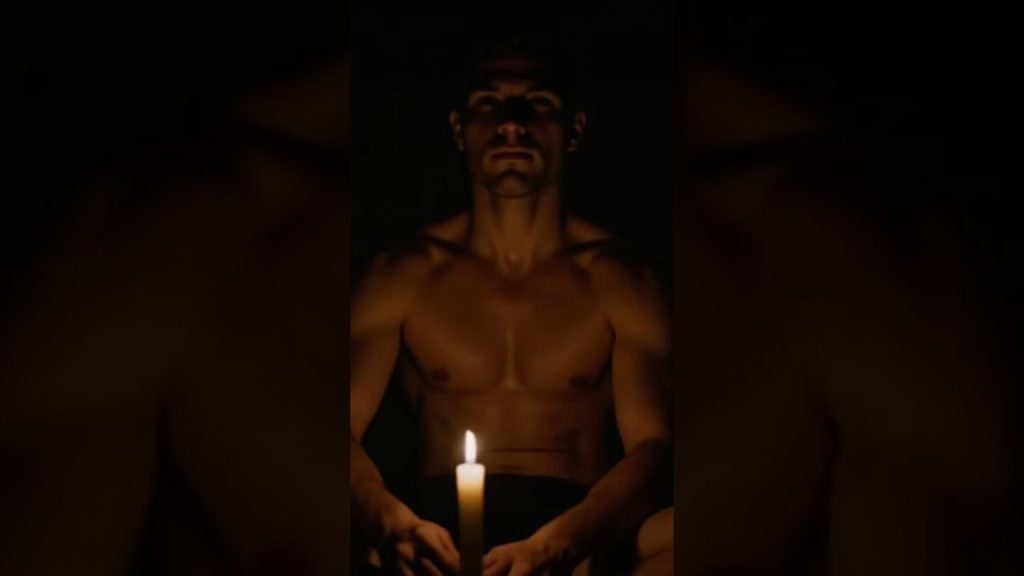
For a men’s community whose members know waiting intimately — waiting to come out, waiting to be seen, waiting for a love that finally recognized us, waiting for a world that has not yet come — Advent is one of the richest and least generic seasons in the Christian year.
History
The season emerged slowly in the early centuries of the Church. Gregory of Tours mentions a fast of preparation for the Feast of Saint Martin on November 11 that eventually spanned the weeks leading to Epiphany on January 6. By the sixth century, under Pope Gregory the Great, the Western Church had settled Advent at four Sundays preceding Christmas. The Eastern Churches kept a longer “Nativity Fast” of forty days.
The Advent wreath — a circle of evergreen, four candles arranged on it, lit one each Sunday — is a nineteenth-century invention, often traced to the German Lutheran pastor Johann Hinrich Wichern, who in 1839 hung a wagon-wheel decorated with twenty small red candles and four large white ones in the dining hall of his home for orphaned children in Hamburg. One small candle was lit each day of Advent; one of the large candles each Sunday. The children, counting down to Christmas, could see exactly how close the feast was. The practice simplified over time to four candles on an evergreen wreath, and spread across denominations.
The “O Antiphons” — seven ancient Advent hymns sung during the last week of the season (December 17 through 23) — are among the oldest Christian poetry still in continuous liturgical use. Each addresses the coming Christ by one of the titles given in Hebrew scripture: O Wisdom, O Lord, O Root of Jesse, O Key of David, O Dayspring, O King of the Nations, O Emmanuel. Together, their initials in Latin spell “ERO CRAS” — “tomorrow I shall be” — the answer the season has been waiting for.
Observances
In parishes, Advent is marked by the lighting of the wreath at Sunday worship, by preaching focused on the themes of waiting and preparation, by scripture readings from the Hebrew prophets and from the Gospel accounts of John the Baptist and the Annunciation to Mary. Liturgical vestments turn purple (or in some traditions blue) for the season, with the single rose vestment reserved for Gaudete Sunday.
In homes, the Advent wreath often moves to the dinner table, lit at the evening meal. Advent calendars — another nineteenth-century German invention — count down the twenty-four days to Christmas Eve, each small window hiding a scripture verse, a small picture, or a piece of chocolate for children (or honestly, for the rest of us). Some families hold a daily Jesse tree, hanging a symbol each day from the Hebrew scripture lineage that leads to Jesus. Others keep a quiet reading practice through the season, often from Isaiah or from one of the contemplative modern Advent writers — Henri Nouwen, Jan Richardson, Walter Brueggemann.
Observances outside Christianity have taken on some of the same shape in a secular key: the four weeks leading up to the end of the year are, for many people of any faith or none, a season of candles, reflection, and preparation.
Male Perspective
The Circle gathers men of every orientation and gender identity, and Advent is a season that calls to all of us. Waiting is one of the oldest human spiritual experiences — waiting for someone to come home, for an answer, for change, for healing, for peace, for the courage to speak what has gone unspoken. Every man carries his own list of what he is waiting for.
Some of the deepest writing on Advent waiting has come from within the queer tradition. The Dutch Catholic priest Henri Nouwen — one of the most-read spiritual writers of the twentieth century, and a celibate gay man — wrote often that “to wait with openness and trust is an enormously radical attitude toward life.” Waiting, in Nouwen’s sense, is not resignation; it is the discipline of staying present to what has not yet come, without rushing it, without despair.
For LGBTQ+ brothers in the Circle, Advent carries specific resonance. Waiting for recognition, waiting for family reconciliation, waiting through the long AIDS years when every day seemed to bring another funeral — these are experiences that shaped the vocabulary of queer spiritual life, and they are a gift the queer tradition offers the broader community of men who come to this season.
For straight brothers whose waiting is of a different kind — for a child’s safe return, for a diagnosis, for a marriage to find its footing, for a father to say the thing he never said — the invitation of Advent is the same. The waiting itself is a form of prayer. The lighting of a candle in the darkening half of the year is a way of saying: I am still here, and I have not given up.
Advent offers every man in the Circle four weeks set aside to simply name what he is waiting for, to light small lights, and to recognize that the waiting itself has meaning.
Summary
Advent is the Christian year’s season of waiting, and it is one of the few seasons on any calendar that was practically designed for people who know what long waiting feels like. For the men of Jonathan’s Circle, the four weeks before Christmas can be a time to light candles, to read quietly, to acknowledge what we are still watching for — and to hold the ancient hope that the dark gives way to light.