For a men’s community that has been shaped, generation after generation, by loss — by AIDS, by suicide, by families that cast out, by the thousand quiet departures that mark any long life — All Souls Day is a feast that fits our shape. It gives us a day set aside to say the names of our dead.
History
The practice of praying for the dead is ancient in Christianity. Early inscriptions in the Roman catacombs ask the faithful to pray for the deceased by name, and by the fourth century individual monasteries were keeping days of commemoration for their departed brothers. The feast as a universal observance, though, dates to 998 CE, when Saint Odilo, the abbot of Cluny, instructed every Cluniac monastery to observe November 2 as a day of prayer and almsgiving for all the dead. Cluny was then the most influential monastic network in Europe; the practice spread quickly, and by the thirteenth century it had been adopted across the Western Church.
The timing was deliberate. Pope Gregory III had already moved All Saints Day from May to November 1 in the eighth century, settling it near the old Celtic festival of Samhain. Placing the commemoration of all the departed the day after made Allhallowtide a single arc: the eve of the veil (October 31), the honored saints (November 1), and the ordinary dead (November 2). Together the three days form one unbroken company of the living and the dead.
The Eastern Orthodox tradition observes several All Souls Saturdays through the year — one before the start of Great Lent, several during Lent, and one before Pentecost — rather than concentrating the commemoration on a single day. The Anglican Communion observes All Souls as the Commemoration of the Faithful Departed; many Lutheran and Methodist churches keep the day as well.
Observances
In Catholic practice the day is marked by Requiem Mass, often celebrated in black, violet, or white vestments. The familiar prayer is simple: “Eternal rest grant unto them, O Lord, and let perpetual light shine upon them. May they rest in peace. Amen.”
In many parishes the names of the departed from the past year are read aloud, a candle is lit for each, and a book of remembrance sits open through the month of November so that families can add names of their beloved dead. In some traditions parishioners bring photos of the departed to lay before the altar.
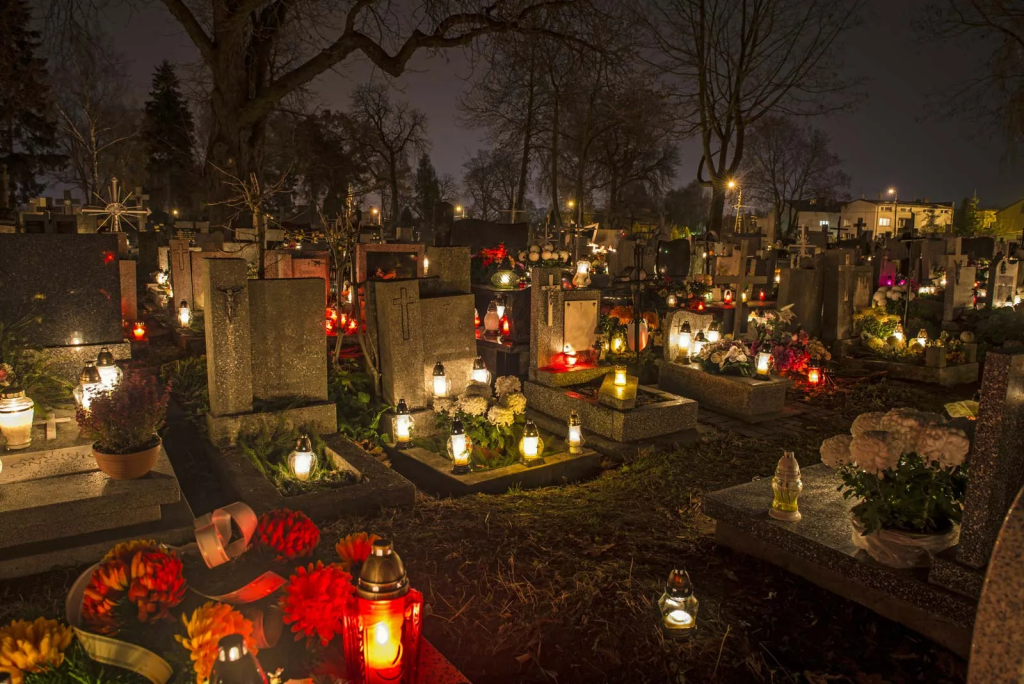
Beyond the church, the day shapes the quieter half of the Day of the Dead observance in Mexico and the broader Latino world: November 2 is the day for honoring deceased adults (November 1 being the day for children). Families visit cemeteries, clean graves, tend flowers (especially chrysanthemums in Europe, marigolds in Mexico), and share meals with the departed in mind.
Private observances are often as simple as a lit candle, a photograph on the mantel, a glass of wine poured for someone who no longer drinks from this side, a prayer spoken into the silence of an empty room.
Male Perspective
Jonathan’s Circle is a brotherhood of men of every orientation and gender identity, and All Souls Day is a day for all of us. It is the day the Christian tradition sets aside to remember the beloved dead — fathers, mothers, friends, brothers, lovers, teachers, children — anyone whose name we still carry. Every man in the Circle has such names.
The day also carries a specifically queer weight that is part of our shared story. Between 1981 and the mid-1990s, in the United States alone, more than 300,000 men died of AIDS. The great majority were gay or bisexual men, most of them in the prime of life. A generation of elders, teachers, lovers, and first mentors into community — gone, often alone, often after being cast out of their families, often with their names erased from obituaries that would not say what they died of.
This is why the AIDS Memorial Quilt reads so unmistakably as an All Souls Day artifact. Each panel is three feet by six — the size of a grave. Each panel bears a name. When the Quilt is unfolded and the names are read aloud, as they have been in cities around the world for forty years, it is the ancient Catholic practice of reading the names of the faithful departed on November 2, enacted by a community that was often denied the churches’ own rites of burial.
All Souls Day is also a day to remember men whose deaths were not from AIDS but from the shape of the closet itself — suicide, overdose, the slow violence of being told a life was wrong. And it is a day to remember the men who did not die young — the ones who lived into old age in a world that mostly did not want them, and who are now entering their own last chapter as elders of a tribe that lost a generation.
For every brother in the Circle, straight or gay, bisexual or transgender, All Souls Day has become a day for lighting a candle, speaking a name aloud, and letting the beloved dead be present at the table — in whatever quiet way the day permits.
Summary
All Souls Day is the hush at the end of Allhallowtide. If All Saints is the day for the heroes of the faith, All Souls is the day for everyone — the ordinary dead, the forgotten dead, the dead whom only we remember. For the men of Jonathan’s Circle, November 2 is a natural companion to the quilt and the candle: a day to say the names and let the long communion of our departed brothers be present with us.