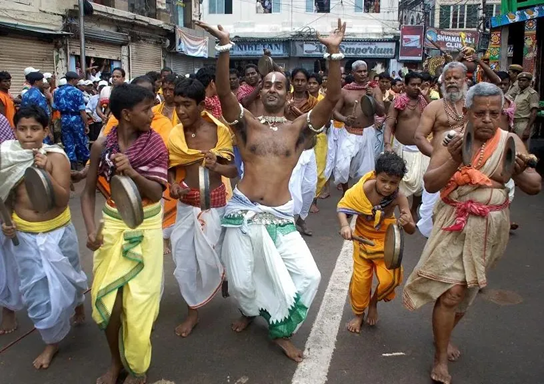
What makes Rath Yatra distinctive within Hinduism is its inversion of the usual movement of devotion. In most Hindu observance, devotees come to the temple to receive darshan — the sacred sight — of the enshrined deity. On Rath Yatra, the deity comes out to meet the devotees. The chariots leave the temple; the deities take to the public road; the lord of the universe spends nine days in a smaller temple that, in the festival’s telling, is his aunt’s home. The festival’s emphasis on radical accessibility is one of its most striking features. Anyone may touch the chariots and pull the ropes — anyone, regardless of caste, regardless of religion, regardless of nationality. This was true centuries before the modern political language for it existed.
For Jonathan’s Circle, Rath Yatra is an invitation to encounter a tradition in which the divine is unapologetically embodied, public, and shared by every available hand. The image at the heart of the festival — tens of thousands of men together pulling a wooden chariot through the streets, hand over hand on the same rope — is among the most direct images of collective brotherhood in religious life anywhere in the world. For Indian and Indian-diaspora Circle members, the day is part of an inherited rhythm. For Circle members from other traditions, it is a chance to take in a form of devotion that does not look much like anything Western religion offers.
History
The Rath Yatra is among the oldest continuously observed religious festivals on earth. Its origins are described in the Skanda Purana, the Brahma Purana, and the Narada Purana, and its present form has been performed without interruption — through invasions, dynastic changes, colonial rule, and modern political upheaval — for at least a thousand years. The current Jagannath Temple in Puri was built in the twelfth century by King Anantavarman Chodaganga, on the site of older temples. Religious traditions associated with the site likely predate the temple by many centuries.
The traditional story locates Jagannath’s origin in the vision of King Indradyumna of Malwa, who was directed by Vishnu to find a sacred log washed ashore on the Puri coast and to have it carved into the form of the lord. The divine craftsman Vishvakarma agreed to undertake the carving, on the condition that no one disturb him until the work was finished; when the king grew impatient and looked in, Vishvakarma vanished, leaving the deities in their characteristic unfinished form — wide eyes, abstract features, stumps where arms would be. The wooden forms of Jagannath, Balabhadra, and Subhadra are renewed every twelve to nineteen years in the elaborate Nabakalebara ritual, when new figures are carved from neem trees identified by specific sacred signs.
The three chariots are built fresh each year by hereditary craftsmen using techniques that have not changed in centuries. Nandighosh, Jagannath’s chariot, stands about 45 feet tall with sixteen wheels. Taladhwaja, Balabhadra’s chariot, has fourteen wheels. Darpadalana (also called Devadalana), Subhadra’s chariot, has twelve. The chariots are assembled in the streets of Puri in the weeks before the festival, without a single nail, using rope-lashing techniques (nawagumi) developed for the purpose. After the festival, the wood from the chariots is broken down and used in temple kitchens for the rest of the year.
Observances
The Rath Yatra calendar begins weeks before the chariot procession itself. Snana Purnima, the Bathing Festival, occurs on the full moon of Jyestha (June 9 this year), when the deities are bathed with 108 pots of water on a special platform. After the bath, the deities are believed to fall ill and enter Ansara, a 14-day period of seclusion during which they are not visible to the public. They emerge restored on the day before Rath Yatra. On the morning of the festival itself, the deities are carried in a ritual procession called Pahandi from the temple to their respective chariots.
Once the chariots are loaded, the Gajapati King of Puri — descendant of the medieval rulers and traditionally regarded as the first servant of Jagannath — performs the Chera Pahara, the ceremonial sweeping of the chariots with a gold-handled broom. This is one of the most loved moments of the day: the king bows and sweeps before the god, a public enactment of the principle that before Jagannath, all distinctions of rank dissolve. The chariots are then pulled by tens of thousands of devotees on long ropes, slowly traveling the three-kilometer route to the Gundicha Temple. The deities stay there for nine days. On the return journey, the Bahuda Yatra (July 24 in 2026), the chariots make a stop at the Mausi Maa Temple, where Jagannath traditionally receives an offering of poda pitha, a specific kind of baked rice cake said to be his favorite.
Rath Yatra is now observed globally. ISKCON (the International Society for Krishna Consciousness, often known as the Hare Krishna movement) organizes chariot festivals in cities around the world: London’s Rath Yatra in Trafalgar Square, New York’s on Fifth Avenue, San Francisco’s in Golden Gate Park, Sydney’s, Toronto’s, and many others. These observances bring scaled-down versions of the Puri procession to urban centers where Hindu diaspora communities and Western devotees pull the ropes together. Cities with significant Odia and broader Indian communities often hold smaller community-organized celebrations as well.
Male Perspective
Jagannath’s unfinished form deserves attention. Most Hindu deities are depicted in refined, anatomically detailed sculpture; Jagannath is deliberately abstract, with wide round eyes, dark skin, and stumps where his arms would be. The traditional story attributes this to the interrupted carving; many readers see something else in it — a deity who refuses polish, who remains rough-hewn and incomplete, whose holiness is in his very refusal to be tidied up. For Circle members who have spent years working with bodies and selves that do not meet the cultural template of finish and perfection, the iconography is worth sitting with. Jagannath is the lord of the universe in a form most religions would not have permitted.
The image of the chariot pull is the festival’s most powerful gift to the Circle. Thousands of men, hand over hand on a single rope, slowly moving an enormous wooden structure through a city — this is collective brotherhood given physical form. No single man can move the chariot. Every man who pulls is essential. The work is slow, communal, sweaty, and devotional all at once. The festival’s insistence that anyone may pull — across caste, religion, and origin — has made it one of the more democratic religious events in the world, centuries before the political vocabulary for that existed.
For gay and queer Circle members, the broader Hindu tradition holds its own queer threads — the third-gender Hijra communities (whose historical recognition predates the modern Western language of trans identity), the legend of Mohini (Vishnu’s female form), the iconography of Ardhanarishvara (the half-male, half-female form of Shiva). These are not directly part of Rath Yatra, but they are part of the larger devotional world the festival lives in — a world in which gender and embodiment have been imagined with considerably more flexibility than the modern Abrahamic mainstream has often allowed.
A practical observance: if there is an ISKCON Rath Yatra in your city — and there is one in many — go pull a rope. The festival is open; the welcome is real; the experience of standing in a crowd of thousands of men moving a chariot together is unforgettable. If no procession is accessible, watch the live stream from Puri (broadcast every year); read a piece on Jagannath iconography; share a meal with a Hindu friend or neighbor. For Indian-diaspora Circle members for whom this is inherited rhythm, the day is yours to mark in whatever way your family marks it. For everyone else, it is one of the great religious festivals of the world, and the chariot is available.
Summary
Jagannath Rath Yatra is the day the lord of the universe comes out into the streets and lets anyone who shows up pull the rope. The festival’s gift to the Circle is its image of brotherhood as collective physical work — slow, communal, devotional, and open to every hand.