Within Hinduism, the day is also called Vyasa Purnima, honoring the sage Vyasa, who is traditionally credited with compiling the four Vedas, authoring the Mahabharata, and beginning the Brahma Sutras on this very day. Within Buddhism, the same full moon is observed as Asalha Puja or Dhamma Day, commemorating the Buddha’s first sermon at Sarnath, which formally established the Sangha and the Four Noble Truths. Within Jainism, the day marks Mahavira’s acceptance of his first disciple, Gautam Swami. Three different traditions, the same lunar moment, the same recognition: this is the day teaching is honored.
For Jonathan’s Circle, Guru Purnima resonates with something the Circle takes seriously: the long work of being shaped by elders. Every man in the Circle has been formed by teachers — some named, some uncredited; some spiritual, some academic; some kept close for decades, some encountered briefly but never forgotten. The day asks attention to that lineage. It is also, more quietly, an invitation to consider what kind of teacher each of us has become in turn — because every brother in the Circle is at this point, willingly or not, a teacher to someone younger.
History
The earliest observances of Guru Purnima are tied to the figure of Vyasa (Krishna Dvaipayana Vyasa), one of the central figures of the Hindu canon. Vyasa is traditionally said to have been born on the full moon of Ashadha, to have divided the original single Veda into the four Vedas we know today, to have authored the eighteen Puranas and the Mahabharata, and to have composed the Brahma Sutras beginning on this day. Whether or not Vyasa was a single historical figure is a question scholars have argued for a long time; in tradition he is the original compiler, the first guru, the figure to whom the lineage of all subsequent teachers traces back. Hindu monastic orders today still mark the day with the recitation of texts associated with him.
Within the Theravada Buddhist tradition, the same full moon is Asalha Puja Day — the day the Buddha gave his first sermon, the Dhammacakkappavattana Sutta, at the Deer Park in Sarnath, near present-day Varanasi. In that sermon he taught the Four Noble Truths to the five ascetics who had been his companions in austerity, and they became the first members of the Sangha — making the Buddha, by the formal logic of the moment, the first Buddhist guru. The simultaneity of the two observances on the same lunar day is not coincidence. The full moon of Ashadha was already a sacred day in the broader Indian religious calendar before the Buddha’s lifetime, and the Buddhist tradition placed the first sermon there for reasons that include the existing weight of the day.
Jain tradition holds that on this day Mahavira, the twenty-fourth Tirthankara, gave his first sermon after attaining omniscience and accepted Gautam Swami as his first disciple. The day is honored across Jain communities as the foundation moment of the Jain Sangha. Over the centuries the festival has grown well beyond its religious origins. In contemporary India, students at music academies, dance schools, martial arts dojos, and other lineage-based learning traditions mark the day by honoring their teachers; many universities and schools hold public observances; political and cultural figures publicly acknowledge mentors. The original meaning has expanded outward without losing its center.
Observances
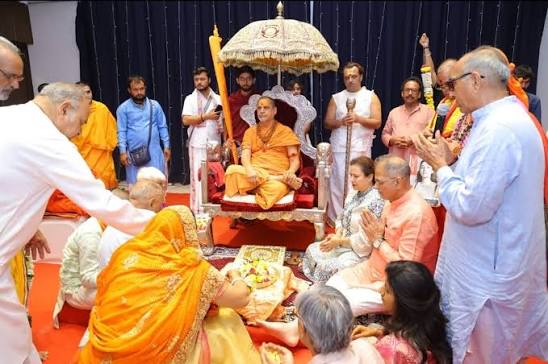
Traditional Hindu observance centers on the honoring of one’s own guru, if one has been formally received into a teaching lineage. Disciples offer flowers, fruits, sweets, and sometimes monetary gifts (guru dakshina) to the teacher. In some lineages, the formal ritual of padapuja — the washing of the guru’s feet — is performed; in others the observance is simpler, a meeting and an exchange of blessings. Many people travel to their guru’s ashram, monastery, or home for the day. For those whose teachers have died, the day is spent at the samadhi (memorial site) or in contemplation of the lineage.
Buddhist observance of Asalha Puja Day includes temple visits, the recitation of the Dhammacakkappavattana Sutta, dharma talks, and the formal observance of the eight precepts for the day. In Thailand, Sri Lanka, Cambodia, Laos, and Myanmar the day is a public holiday. The day before the beginning of Vassa, the three-month rains retreat during which Buddhist monks remain in their monasteries, falls the day after Asalha Puja; the two days together form a major monastic observance. In the West, Buddhist centers across the major Theravada and Mahayana traditions hold special programs on or near the day.
Beyond the formal religious traditions, the day is observed by students of music (especially Hindustani and Carnatic classical lineages), classical dance, martial arts, yoga, and other guru-based disciplines. It is common for students to gather, perform for their teacher, present a small gift, and take the opportunity to formally renew their commitment to the practice. In the diaspora, Indian-origin communities in North America, the UK, Australia, and elsewhere organize public Guru Purnima observances at temples, cultural centers, and yoga studios. Many spiritual organizations of Indian origin — Self-Realization Fellowship, ISKCON, the Art of Living Foundation, and many smaller lineages — mark the day prominently.
Male Perspective
Every man in the Circle has been shaped by teachers, and most of those teachers were men. Some were named — the music teacher who first showed you how to feel a phrase, the priest or rabbi who took your questions seriously, the professor whose office hours you stayed too long in, the therapist who waited you out. Some were not — the uncle who let you cry without comment, the older friend who told you the truth about your father, the man at work who took you aside when no one else would have. The lineage of teachers is rarely formal and almost never complete. Guru Purnima is an invitation to name the ones who shaped you.
For gay and queer Circle members, the question of elders takes on a particular weight. The AIDS years removed an entire generation of natural elders from gay community life — the men in their forties and fifties who would have been mentors to younger gay men in the nineties and two thousands. The gay men who survived to teach the next generation often did so while grieving the men who would have done that work alongside them. For younger gay Circle members, the elders who taught you how to navigate gay life — how to be in a body, how to be in love, how to be in community — gave you something the demographics had nearly made impossible. Naming them is a serious act.
For straight Circle members, the day asks attention to the men who shaped you into the kind of man you are — for better and for worse. Fathers, stepfathers, coaches, scout leaders, military superiors, bosses, the older brothers of friends. Some of these men taught you well. Some taught you what you have spent decades unlearning. The Circle’s commitment to honest formation means the day can hold both — the gratitude and the inventory, the men you are still trying to thank and the men you are still trying to be different from. The honest version of teacher-honoring is not sentimental.
And there is the other half of the day, which the Circle especially should not skip. By now, almost every man in the Circle is a teacher to someone — a younger brother, a son, a nephew, a junior colleague, a newer Circle member, a man you do not know is watching but who is. Guru Purnima is half about honoring the teachers above you and half about taking honest stock of the teaching you are doing below you. A practical observance: name three teachers from your life and reach out to one of them this week — a phone call, an email, a visit if you can. Then name three people for whom you are now a teacher, and ask yourself, this week, whether the teaching you are giving them is the teaching you would want.
Summary
Guru Purnima honors the long line of teachers who have shaped each of us, and it asks us to take honest stock of the teaching we are now doing in turn. The Circle is a place where both directions of that work are taken seriously.