The scale of the community is enormous. The CDC estimates that more than one in four American adults — over seventy million people — live with some form of disability. The majority of those disabilities are invisible: chronic illness, mental health conditions, neurodivergence, sensory impairments, chronic pain. Disability is also the one identity category that most humans will eventually join, by aging if nothing else.
For Jonathan’s Circle, Disability Pride Month is an invitation to widen the circle deliberately. Disabled men have always been part of our membership — visibly and invisibly, by birth and by acquisition. The month asks the rest of the Circle not for sympathy but for concrete attention: to how we gather, how we communicate, how we describe our retreats, how we honor what each brother can and cannot do.
History
The Americans with Disabilities Act did not arrive from nowhere. The disability rights movement had been building for decades — through veterans returning from Vietnam, through Ed Roberts and the Independent Living Movement at UC Berkeley in the 1960s, through parents of disabled children pressing for educational access. The movement’s slogan, Nothing About Us Without Us, became a touchstone for self-representation across many other liberation movements.
The decisive moment came in April 1977: the 504 Sit-In. Section 504 of the Rehabilitation Act of 1973 had prohibited federally funded programs from discriminating against disabled people, but the Department of Health, Education, and Welfare had refused for four years to issue implementing regulations. Disabled activists occupied federal buildings across the country. The longest occupation — 25 days at HEW’s San Francisco office — was led by Judy Heumann, supported by the Black Panthers, who delivered hot meals daily, and Glide Memorial Church. The sit-in ended when Secretary Joseph Califano signed the regulations.
Pre-ADA America was not gentle to its disabled citizens. For most of the twentieth century, U.S. disability policy meant institutionalization, and the eugenics movement targeted disabled people through forced sterilization campaigns whose legal foundation — Buck v. Bell, the Supreme Court’s 1927 decision approving the sterilization of Carrie Buck — has never been overturned. The 1999 Olmstead v. L.C. decision affirmed the right of disabled people to live in community rather than institutions, a right still contested in ongoing fights over Medicaid home-and-community-based services.
Observances
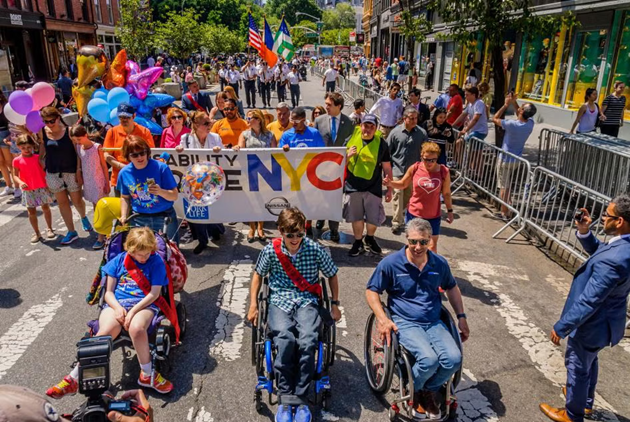
Parades and public gatherings are the most visible element of the month. Chicago’s annual Disability Pride Parade — the largest in the United States, typically held the third Saturday of July — was the first of its kind, founded in 2004. New York City’s parade followed in 2015 for the 25th anniversary of the ADA, and similar events are held in Boston, Brighton, and elsewhere. Wheelchair users, deaf folks signing along with music, blind marchers, people with chronic illnesses, neurodivergent contingents, and mental health survivor organizations all come into the same street at the same time — the full range of disability experience visible at once, in public, by choice.
The Disability Pride Flag is everywhere during the month. Designed by Ann Magill, a disabled writer, in 2019, the flag features five parallel diagonal stripes against a black field — red for physical disability, gold for cognitive and intellectual disability, white for invisible disability, blue for mental illness, and green for sensory disability. The black field represents grief for those lost to ableism and institutional neglect. Magill revised the design in 2021 after learning the original pattern could trigger migraines and seizures in some viewers; the muted version is now in standard use — a small piece of design done with disabled people in mind.
Cultural programming proliferates: panels, screenings, history reading groups. The documentary Crip Camp (2020) has become a near-mandatory entry point for newcomers; the canon of disability culture now includes Eli Clare’s Exile and Pride, Audre Lorde’s The Cancer Journals, Leah Lakshmi Piepzna-Samarasinha’s Care Work, and Alice Wong’s anthology Disability Visibility. Identity-first language (disabled person) is now generally preferred over person-first (person with a disability), though autistic and Deaf communities especially have their own conventions; the general guidance is to ask, and use what the person tells you.
Male Perspective
Disabled men have always been part of the Circle. Disability is the most numerically common form of marginalization, and most of it is invisible — chronic illness, mental health diagnoses, neurodivergence, chronic pain, sensory impairments, mobility differences, the long tail of HIV-related conditions. The fact that a brother in your Online Gathering looks fine does not tell you what he is managing in order to be present. Most disabled adults were not born disabled, either; disability comes through accidents, illness, and most commonly aging. It is a passage nearly every man in the Circle will eventually be on. The question is whether the Circle will be a place that knows how to welcome him through it.
The intersection with gay community history is real and significant. HIV/AIDS produced an entire generation of men who became disabled in young or middle adulthood and who lived — and continue to live — with disability as a permanent dimension of their lives. Long-term HIV survivors are among the most experienced disabled men in the Circle, with hard-earned knowledge of how to live well with a body that requires constant tending. The gay men’s health movement that organized around AIDS, and that continues today around aging and serodifferent relationships, has produced models of community care that the broader disability movement recognizes as kin.
For gay disabled Circle members specifically, the negotiation is layered. Gay community spaces — bars, gyms, sex-positive spaces, beaches — are often not physically accessible. The premium gay culture has historically placed on a narrow ideal of male physical perfection is in direct tension with disabled male embodiment, and the broader desexualization of disabled people in the dominant culture compounds the gay-specific bind: disabled gay men frequently encounter the assumption that they are not sexual beings at all. The Circle’s commitment to integrating spirit and eros gives us a particular obligation here — to welcome the disabled erotic life of our brothers without pitying it or exoticizing it. For straight Circle members, the month invites parallel reflection on the cultural script that equates manhood with productivity, with strength, with the able body that does the heavy lifting — a script that disability cuts directly against, and that has often forced the disabled straight man to invent his own way of being a man because the inherited form no longer fits.
A practical observance: ask the brothers in your Circle what they need. Not in the abstract — concretely. Captioning on Zoom. A scent-free retreat space. Read-aloud option for the newsletter. A buddy on retreat for someone with a balance issue. Pace. Rest breaks. The promise that no one will be asked to do an activity their body cannot do. These are not extras; they are the form Circle hospitality takes for disabled brothers. Read at least one piece of disability culture this month — Eli Clare, Alice Wong, the Crip Camp film. Then ask one disabled brother how the Circle could meet him better. Listen to what he says.
Summary
Disability Pride Month claims the truth that the disabled body, the disabled mind, the disabled life is not a problem to be solved but a way of being human that has its own integrity, dignity, and erotic life. The month asks the Circle to widen — deliberately, concretely, in the way our gatherings are actually shaped.