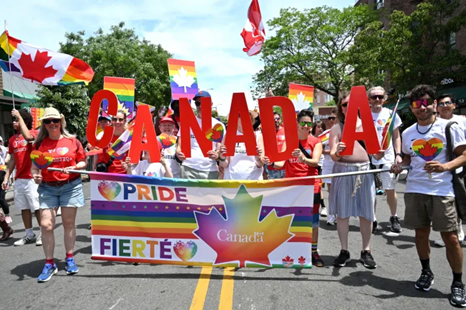
July is one of the busiest stretches of the season. Halifax Pride — the largest in Atlantic Canada — is held in July, along with Fierté Fredericton, St. John’s Pride, and the PEI Pride Festival. Vancouver Pride begins its multi-week build-up toward early August. Toronto’s massive June Pride, among the largest in North America, has just wrapped. Smaller community Prides across the country fill in the gaps. By the end of July, most Canadians have been within easy reach of a Pride event.
For Jonathan’s Circle, the July observance of Canadian Pride is a chance to remember that Pride is not a single American calendar tradition but a many-voiced movement with distinct national histories. Canadian Circle members will recognize the seasonal rhythm. For the rest of us, July invites attention to the parts of the Pride story that are not ours — and to the brothers in our membership whose Pride experience is shaped by a different national history, a different political moment, and a different set of organizing traditions.
History
Canadian queer history is genuinely distinct from American queer history. The decriminalization of homosexuality in Canada came in 1969, with the Criminal Law Amendment Act championed by then-Justice Minister Pierre Trudeau, who delivered the famous line, “There’s no place for the state in the bedrooms of the nation.” The legal framework that followed was uneven and partial, but the federal-level break happened four years before the American Psychiatric Association removed homosexuality from the DSM and two decades before the U.S. Supreme Court decriminalized same-sex intimacy in Lawrence v. Texas (2003).
Canada’s own Stonewall moment came on August 28, 1971, with the “We Demand” protests in Ottawa and Vancouver — the first large-scale LGBTQ+ demonstrations in Canadian history. The protest delivered a ten-point brief to Parliament and is the reason many older Canadian Pride observances are anchored in August rather than June. The 1981 Operation Soap bathhouse raids in Toronto, in which Toronto Police arrested nearly three hundred men in coordinated raids on four bathhouses, is often called Canada’s Stonewall; the protests that followed transformed Toronto’s gay community organizing and produced Pride Toronto’s first parade in June of that year.
Quebec became the first jurisdiction in Canada — and one of the first in the world — to add sexual orientation to its provincial human rights charter, in 1977. Canada was the fourth country to federally legalize same-sex marriage, with the Civil Marriage Act of 2005, a decade before the U.S. Obergefell decision. Gender expression and gender identity were added to the Canadian Human Rights Act in 2017, the same year Prime Minister Justin Trudeau delivered a formal apology in Parliament for the federal government’s historical persecution of LGBTQ+ Canadians — including the Cold War–era purges that drove suspected queer people out of the public service and the military.
Observances
The July Pride calendar in Canada is densest in the Atlantic provinces. Halifax Pride runs roughly two weeks in mid- to late July and is the largest 2SLGBTQI+ event east of Montreal. Fierté Fredericton, St. John’s Pride, and the PEI Pride Festival follow their own July rhythms. Vancouver Pride’s opening events begin in late July before the early-August parade. Many smaller communities — particularly in the Prairies, Northern Ontario, and Atlantic Canada — choose July because June weather is still uncertain in much of the country.
The acronym in standard use across Canadian Pride is 2SLGBTQI+ — Two-Spirit, lesbian, gay, bisexual, transgender, queer, intersex, and additional identities. The 2S is placed first deliberately, to honour the historical and cultural significance of sexual and gender diversity within First Nations, Inuit, and Métis communities before colonization. This is a substantive ethical choice, not a letter shuffle: it places Indigenous queer identities first in the order of recognition. Many Canadian Prides include Two-Spirit gatherings and ceremonies that are organized by Indigenous-led organizations and are not always public events.
Public Service Pride Week, held the third week of August, is a distinctly Canadian observance — a recognition of the LGBTQ+ federal workforce that emerged in the aftermath of the Cold War purges. Many Canadian Prides also include a Trans March (Toronto held the first in Canada, in 2009) and a Dyke March as their own distinct events alongside the main parade. The political register of Canadian Pride varies city to city: Toronto’s long-running debates over the participation of uniformed police are one of the most visible examples of how Pride remains an active political conversation, not just a celebration.
Male Perspective
For Canadian Circle members, the seasonal shape of Pride means the observance unfolds in pieces across the summer rather than peaking in a single month. There is a different rhythm to lived Canadian Pride experience — the Atlantic Canada brother whose July is Halifax, the Vancouver brother whose Pride builds through late July into early August, the Toronto brother whose June Pride is the big civic moment, the Ottawa brother for whom Pride happens in August during the parliamentary recess. For non-Canadian Circle members, the season is an invitation to notice that Pride looks different elsewhere — and that the U.S. June calendar is not the universal default.
The Two-Spirit dimension of Canadian Pride deserves particular attention. Indigenous queer and gender-diverse traditions in North America predate the colonial categories that the LGBTQ+ acronym was built from, and Canadian Pride’s 2S framing has tried — with varying success across cities and years — to keep that visible. For Indigenous Circle members, this can be more central to Pride than it tends to be in U.S. observances. For settler Circle members of any orientation, the month is an invitation to learn from Two-Spirit writers and organizers rather than speak for them. The work of writers like Joshua Whitehead, Daniel Heath Justice, and Billy-Ray Belcourt is a strong starting point.
The bathhouse raid history matters too. Toronto’s Operation Soap in 1981, Montreal’s Truxx raid in 1976, and other smaller raids produced a generation of Canadian gay men whose coming-of-age was shaped by resistance to specifically Canadian state violence — a different collective memory than the U.S. AIDS-era one that defines much of the older American Circle membership. The Canadian apology delivered by Justin Trudeau in 2017 named what had been done to gay public servants and military members; it remains one of the more substantive state apologies any LGBTQ+ community has received.
A practical observance: if you are not Canadian, take the month to read one piece of Canadian queer history or literature — Joshua Whitehead’s Jonny Appleseed, John Greyson’s film Lilies, Sarah Schulman’s coverage of the Toronto bathhouse raids, or any of the standing histories of the We Demand protest. If you are Canadian, the season ahead is yours — show up to a parade if you can, and welcome the next generation as you were welcomed. For Indigenous Circle members in Canada, the season is an invitation to claim the front of the acronym.
Summary
Canadian LGBTQ Pride Season is a different shape from its American counterpart — not a month but a summer, not a single Stonewall story but a layered set of national histories that include the 1969 decriminalization, the 1971 We Demand protests, the 1981 bathhouse raids, the 2005 marriage equality law, and the 2017 federal apology. The season asks attention to a Pride story that is parallel to the American one, not derivative of it.