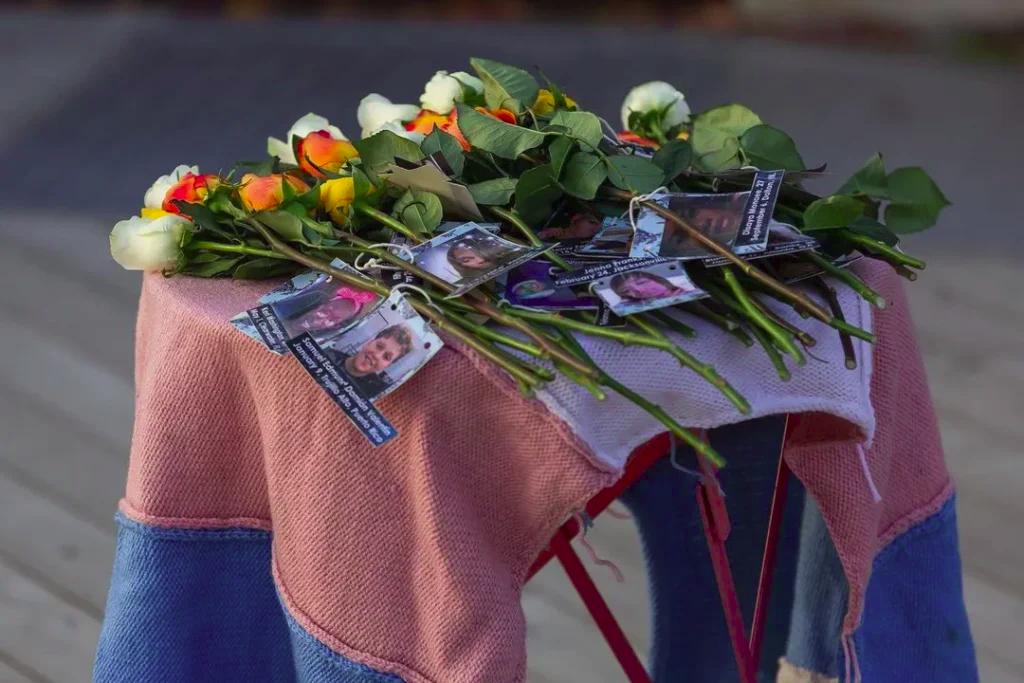
For a men’s community that counts trans brothers among its members and allies, TDoR is a day of solidarity, grief, and resolve.
History
The day was founded in 1999 by Gwendolyn Ann Smith, a trans graphic designer and activist, in response to the murder of Rita Hester — a Black trans woman killed in her apartment in Allston, Massachusetts on November 28, 1998. Hester’s murder, like so many murders of trans women of color before and since, went almost entirely uninvestigated and unreported outside the trans community.
Smith organized a candlelight vigil in San Francisco on November 20, 1999, a year after Hester’s death and in memory of the many trans people who had been killed in the preceding years. The vigil was accompanied by a web project, “Remembering Our Dead,” which maintained an online record of transgender people lost to violence — a necessary archive, since mainstream media and police records regularly misgender murdered trans people or omit the fact of their deaths altogether.
The observance spread rapidly. By 2010, TDoR vigils were held in more than 185 cities and twenty countries. The Trans Murder Monitoring project of Transgender Europe (TGEU) has, since 2008, maintained the most comprehensive available international record of reported murders of trans and gender-diverse people; its annual update is released each year in the days before November 20. The 2024 report named more than 350 reported killings worldwide in the preceding year — and the real number is understood to be much higher, since many killings go unreported, misreported, or deliberately miscategorized.
Observances
The core of a TDoR observance is the reading of the names — a slow, public litany of trans people killed by violence in the past year. Candlelight vigils, memorial services, and processions are the most common forms. Many communities also hold accompanying events: film screenings, community dinners, panels, and liturgies.
Houses of worship across traditions — Episcopal, Lutheran, United Church of Christ, Reform and Reconstructionist Jewish communities, Unitarian Universalist congregations, and others — have incorporated the day into their calendars with special services. Many churches ring their bells once for each name read.
In recent years, the observance has often been held at the end of Transgender Awareness Week (November 13–19), a week of visibility and education that leads into the day of mourning so that the week’s emphasis on trans lives moves naturally into the day’s emphasis on trans deaths.
A private observance can be as simple as lighting a candle, speaking a name, and taking a few minutes to read the current year’s TMM report — the practice of just knowing the names is itself the point.
Male Perspective
Jonathan’s Circle is a brotherhood of men of every orientation and gender identity, and the Transgender Day of Remembrance is a day for every one of us to show up and read the names.
Trans men are our brothers. Trans women fought at Stonewall; it was Marsha P. Johnson and Sylvia Rivera, both trans women of color, who were among the most visible resisters on that first night in June 1969. The modern LGBTQ+ movement exists in the form it does because trans people, especially trans women of color, carried the earliest and the hardest costs of making it possible.
The violence TDoR mourns is specifically male violence, and that is a hard fact for any community of men to sit with. The great majority of trans people killed in anti-trans violence are Black and Latina trans women, and they are overwhelmingly killed by men — often men who had been seeing them privately, often men who had come to believe that the victim’s existence was a threat to the killer’s own masculinity. Any serious men’s community has to reckon with that.
For straight brothers in the Circle, TDoR is an occasion to let that reckoning be unflinching. The violence done to trans women is often done by men who look, from the outside, like ordinary men — like men anyone would recognize as sons, fathers, coworkers, neighbors. The day asks every man to look clearly at that fact without softening it.
For gay and bisexual brothers, the day asks for the specific solidarity that cisgender queer men owe to the trans siblings whose costs built the movement we inherited. Reading the names is one small way of paying it.
For trans brothers in the Circle — this day is heavy, and often more complicated than the public conversation allows. The honoring of trans sisters whose deaths disproportionately make up the roll of names is paired with the quieter reality that trans men also face violence, especially trans men of color, and that trans men’s stories are often made invisible in both the queer community and the broader culture. We see you, and we are glad you are here.
The ask of every man in the Circle on November 20 is the same: show up. Read the names. Let the day stand against the amnesia that would otherwise claim it.
Summary
The Transgender Day of Remembrance is one of the most important days on the LGBTQ+ calendar. For Jonathan’s Circle, November 20 is a day for lighting a candle, reading the names, and standing with trans siblings — both the living and the dead — as the kind of brotherhood we claim to be.