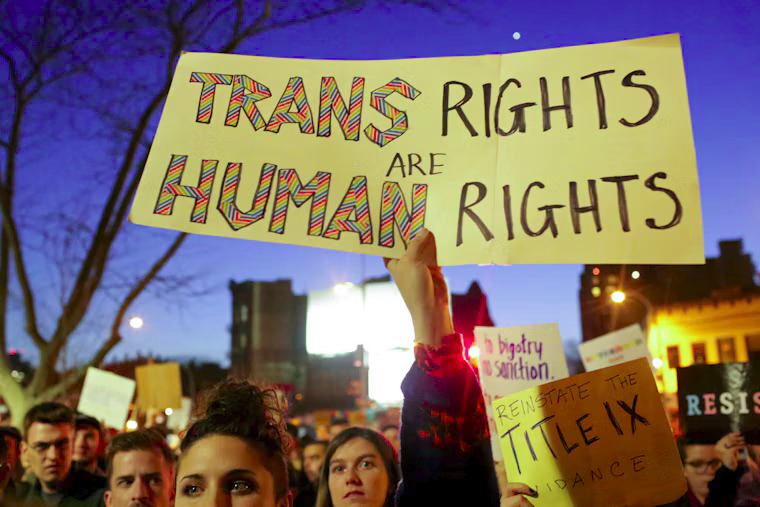
For a men’s community that includes trans brothers and that stands in solidarity with trans siblings across the gender spectrum, the week is a chance to show up with more than mourning.
History
The pairing of a week of visibility with the day of remembrance emerged in the mid-2000s, organized informally at first by trans activists and student groups who wanted to balance the sorrow of November 20 with a week that affirmed trans life. GLAAD, the Human Rights Campaign, and the National Center for Transgender Equality formalized the observance over the following years, each publishing annual guides, campaign materials, and events that have since made the week a fixture of the fall calendar.
The week sits within a cluster of trans visibility observances across the year. International Transgender Day of Visibility is kept on March 31 (founded by Rachel Crandall in 2009). International Pronouns Day is observed on the third Wednesday of October. Together with Transgender Awareness Week and TDoR, these days map a trans calendar of visibility, education, and remembrance that runs through the year.
Observances
Common observances through the week include campus speakers, panels, and film screenings; employer-led education sessions; social-media visibility campaigns featuring trans voices telling their own stories; legislative advocacy coordinated through state and national trans-led organizations; and local community events, especially trans-led gatherings in which trans people are not the subject of discussion but the organizers and hosts.
The week often includes targeted focus days within it — for example, days dedicated to trans men, trans women, nonbinary people, trans people of color, trans elders, or trans youth. These are not formal in the way the week itself is, but they shape the content and the voices foregrounded on particular days.
A private observance of the week is often as simple as reading something written by a trans author, supporting a trans-led organization with a donation, correcting a pronoun or a name in a conversation where you otherwise would have let it slide, or simply watching the week’s offerings and being present to it.
Male Perspective
Jonathan’s Circle is a brotherhood of men of every orientation and gender identity — straight, gay, bisexual, and transgender — and Transgender Awareness Week is a week for all of us.
For trans brothers in the Circle, the week is yours. The week exists because trans lives are still contested in the public conversation and in public policy, and because visibility — real, specific, named visibility — matters when invisibility has been the default. Whatever shape your week takes, we are glad you are here.
For straight, gay, and bisexual cisgender brothers, the week asks a specific thing: pay attention. Trans men are men. Our brotherhood already contains them; it is already shaped by them, whether every one of us has noticed or not. The simplest, most important act of allyship during Transgender Awareness Week is to let trans voices be the ones we listen to — trans journalists, trans poets, trans historians, trans ordinary people writing on social media about ordinary days.
The week also invites a quieter kind of reflection for every brother in the Circle. The version of masculinity each of us was handed — by family, by culture, by church — rarely fit without some negotiation. Trans men know this. Gay men know it. Many straight men know it too, often without having a shared vocabulary for what the negotiation cost. There is a conversation among all four groups about what it takes to make a man’s own masculinity his own, and Transgender Awareness Week is a good time to begin or deepen it.
For everyone in the Circle: show up. Learn a trans brother’s name. Read a trans writer. Let the week be the week it was meant to be.
Summary
Transgender Awareness Week is the week before TDoR, and it carries a different weight: not mourning, but visibility; not loss, but life. For the men of Jonathan’s Circle, the week is a chance to listen, to show up at a reading or an event, to amplify a trans voice, and to let the week’s emphasis on living trans lives change what the following week of remembrance means.