The setting is the Deer Park at Isipatana (now Sarnath, near Varanasi in northern India), where the Buddha sought out the five ascetics who had been his earlier companions in extreme austerity and who had rejected him when he had abandoned that path. The sermon he delivered, known as the Dhammacakkappavattana Sutta — “Setting in Motion the Wheel of the Dhamma” — is among the briefest of the Buddha’s recorded teachings and among the most consequential. By the end of it, the eldest of the five, Kondanna, had attained the first stage of awakening; by week’s end, all five were monks. The Sangha had begun.
For Jonathan’s Circle, Asalha Puja invites attention to two things in particular. The first is the substance of what the Buddha taught — the Four Noble Truths and the Middle Way between asceticism and indulgence, a teaching that takes embodied life seriously and refuses both extreme renunciation and reflexive gratification. The second is the founding of the Sangha as a model of intentional male community organized around a shared practice rather than around birth, tribe, or trade. The Circle is, in its own way, an heir to that experiment.
History
The events Asalha Puja commemorates took place, in the traditional reckoning, in the fifth century BCE. The Buddha — Siddhartha Gautama — had attained enlightenment some weeks earlier at Bodh Gaya, sitting under what is now called the Bodhi tree. He hesitated to teach what he had realized, on the grounds that it would be difficult to convey, and he walked over a period of weeks to the Deer Park, where his five former companions were still practicing the extreme austerities he had abandoned.
The sermon itself begins with the rejection of two extremes: the pursuit of sensual pleasure as a path to truth, and the practice of extreme self-mortification, which the Buddha had himself attempted to the point of near-starvation. The path he proposes between them — the Middle Way — is articulated through the Four Noble Truths: the truth of suffering (dukkha), the truth of the cause of suffering (craving), the truth of the cessation of suffering (the unbinding of craving), and the truth of the path leading to cessation, which is the Noble Eightfold Path. These four truths and the eightfold path are still the structural core of Buddhist teaching, across every later school and tradition.
The day after Asalha Puja begins Vassa — the three-month rains retreat during which Buddhist monks remain within their monastery grounds. The institution of Vassa dates to the Buddha’s own time, and is now one of the most important annual observances in Theravada countries. In Thailand, the beginning of Vassa is marked as Khao Phansa, with candle processions and the giving of large carved wax candles to monasteries. Many laypeople undertake temporary commitments at the start of Vassa — abstaining from alcohol, taking the eight precepts, maintaining a daily meditation practice — that they keep through the three months.
Observances
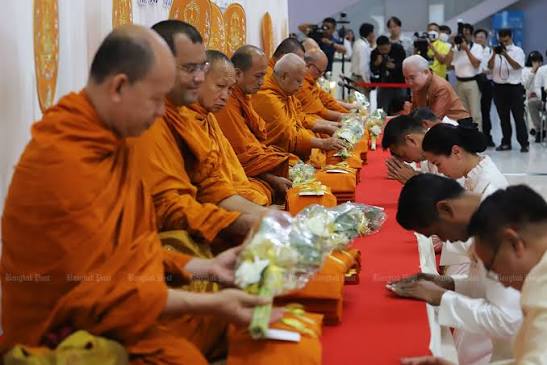
In Theravada Buddhist countries, Asalha Puja is a public holiday and one of the most important observances of the religious year. The day typically begins at a temple, with laypeople bringing food offerings (dana) to the monks. The Dhammacakkappavattana Sutta is recited or chanted in the morning. In the evening, a candlelit procession — wian tian — circles the temple’s central shrine three times in honor of the Three Jewels (Buddha, Dhamma, Sangha). Many laypeople take the eight precepts for the day.
Beyond the formal observance, Asalha Puja is increasingly used as a moment for dharma talks open to the public, for the giving of meditation instruction, and for the formal beginning of intensive meditation retreats. Many Western Buddhist centers — across Insight Meditation, Zen, Tibetan, and other lineages — hold programs on or near the day, often with a focus on the content of the first sermon: a reading of the Dhammacakkappavattana Sutta, a teaching on the Four Noble Truths, a sustained reflection on what the Middle Way actually requires in a contemporary life. These programs are generally open to non-Buddhists.
Not all Buddhist traditions mark the first sermon on this day. Mahayana traditions in China, Korea, Japan, and Vietnam observe related themes on different days. Tibetan Buddhism commemorates the first turning of the wheel as Chokhor Duchen, on the fourth day of the sixth Tibetan lunar month — typically in late July or early August, near but not identical to Asalha Puja. The Buddhist year runs on multiple overlapping calendars; the same underlying event carries different dates across traditions.
Male Perspective
The Buddha had been a husband and a father before he left his palace. He had a wife, Yashodhara, and a son, Rahula, both of whom he abandoned to undertake his spiritual quest. (Both would later, after his enlightenment, themselves ordain.) The full picture of the Buddha’s decision is more morally complicated than the standard hagiography sometimes allows: he left people who loved him and who needed him. The Middle Way he later taught — the path between asceticism and indulgence — is, in part, his account of why the extreme renunciation that took him from his family had to be moved past as well. The first sermon is, among other things, the Buddha’s repudiation of his own earlier extreme.
For Circle members for whom the integration of spirituality and embodied life is a serious project, the Middle Way is one of the more durable frameworks anywhere in religious literature. It is not asceticism; it is not hedonism; it is not a compromise between them. It is a path that takes the suffering produced by craving seriously while refusing the false solution of withdrawal from the body and from the world. The body is not the enemy; craving is the difficulty. Many Circle members have found this framing compatible with — and clarifying for — the Circle’s own commitment to integrating eros and spirit.
Buddhism’s historical position on sexuality has been complicated, and on same-sex relationships specifically it has varied widely across cultures and centuries. The Western Buddhist scene that emerged from the 1960s onward has included significant queer leadership and participation: Issan Dorsey, the gay Zen priest who founded Maitri Hospice for AIDS patients in San Francisco; and the many openly LGBTQ+ teachers across Insight Meditation, Zen, and Tibetan lineages now. The Sangha that meets in many American Buddhist centers today is not the Sangha of the first generation, but the principle — community organized around shared practice — is the same.
A practical observance: read the Dhammacakkappavattana Sutta this week. It is short — most translations run to under a thousand words — and the Access to Insight website (accesstoinsight.org) hosts excellent freely available versions. Sit for twenty minutes after reading it. If there is a public Asalha Puja observance at a Buddhist center near you, consider attending; the day is generally hospitable to non-Buddhists, and the candle procession at dusk is among the more beautiful religious observances in the contemporary American calendar. If you have taken on a daily practice that has slipped, the day after Asalha Puja — when monks begin Vassa — is a traditional moment for laypeople to take up a three-month commitment as well. Choose one and keep it through the autumn equinox.
Summary
Asalha Puja is the day Buddhism became a teaching tradition — the day the Wheel of the Dhamma was set in motion and the first Sangha was formed. The day’s gift to the Circle is the Middle Way: a path that takes embodied life seriously without surrender to either asceticism or indulgence, and a model of community organized around shared practice rather than birth.