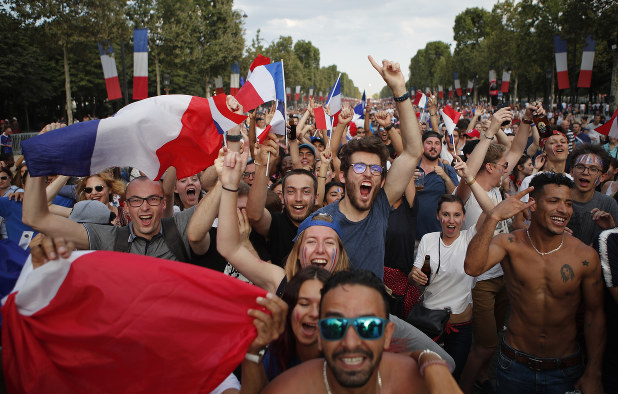
The Revolution that followed produced the Declaration of the Rights of Man and of the Citizen (August 1789), the abolition of feudal privileges, the first modern declaration of secular republican government, and — over the next decade — the Terror, the guillotine, and the chaos that eventually opened the door to Napoleon. The French Revolutionary motto, liberté, égalité, fraternité, entered political language during this period and has shaped republican thought ever since. France remains a country whose national self-understanding is deeply tied to revolutionary origins, in a way few other modern nations match.
For Jonathan’s Circle, Bastille Day is an invitation to consider one word in particular from that revolutionary trio: fraternité. Brotherhood as a civic and political virtue — not merely a feeling among friends, but the practical obligation citizens hold to one another — is a concept the Circle takes seriously and the French tradition has helped shape. The day is also a chance to mark a country whose contributions to queer life, intellectual culture, and the long history of human rights are larger than American observances often acknowledge.
History
The Bastille had served as a state prison since the seventeenth century, often used by royal lettres de cachet to detain people without trial. By the summer of 1789 it was largely empty but still loomed over the Saint-Antoine neighborhood of Paris as a symbol of arbitrary royal power. On July 14, a crowd already in revolt over food prices and the king’s recent dismissal of the reformist finance minister Necker marched on the fortress, both to seize gunpowder stored there and to make a political statement. The governor, the marquis de Launay, was killed; the seven prisoners — four forgers, two men held for mental illness, and one aristocrat detained at his family’s request — were freed.
The Revolution proceeded through a series of phases that bear remembering honestly. The constitutional monarchy phase (1789–1792) produced the Declaration of the Rights of Man and the abolition of noble privileges. The radical Republic phase under the Jacobins (1792–1794) produced the execution of Louis XVI and Marie Antoinette and the Reign of Terror, during which the revolutionary government executed tens of thousands of its own citizens. The Directory and Consulate phases led to Napoleon’s rise. The Revolution that began with the storming of the Bastille was not a single moment but a decade of upheaval that included both the founding of modern republicanism and some of the most violent excesses of the eighteenth century.
July 14 was made the official national holiday in 1880, more than ninety years after the event it commemorates. The choice was deliberate: the Third Republic, founded after the Franco-Prussian War and the Paris Commune, needed a national day, and 1789 offered a moment of revolutionary unity before the bloodier phases that followed. The legislative text adopted that year is careful not to specify which July 14 it commemorates — the storming of the Bastille in 1789, or the Fête de la Fédération of 1790, when the country celebrated its first anniversary in (briefly) unified national mood. The ambiguity has lasted.
Observances
The Champs-Élysées military parade on the morning of July 14 is the oldest and largest regular military parade in Europe. It runs from the Arc de Triomphe to the Place de la Concorde, includes detachments from every branch of the French armed forces, and is reviewed by the President of the Republic from a stand near the Place de la Concorde. Foreign units are often invited to march alongside; the parade is broadcast live across France and watched by millions.
The Bal des pompiers — the firemen’s ball — is the more beloved popular tradition. Beginning the evening of July 13 and continuing through the night of July 14, fire stations across Paris and many other French cities open as public dance halls. Admission is generally free or by token donation. The tradition began in Paris in the 1930s and has spread widely. The Eiffel Tower fireworks on the evening of July 14, set to music, draw enormous crowds to the Champ de Mars and to vantage points across Paris.
French embassies and consulates worldwide host July 14 receptions. In the United States, French Cultural Services in many cities organize public observances, and French diaspora communities — particularly in New York, New Orleans, San Francisco, and a number of southwestern cities with historic French ties — hold their own celebrations. For Americans without French ties, the day is most often marked, if at all, with a meal at a French restaurant or a small gathering with friends; the Bastille Day Pétanque tournament in New York’s Carroll Gardens, the Bastille Day Block Party at Bar Tabac in Brooklyn, and similar events have become local fixtures.
Male Perspective
The Revolution’s contribution to the long arc of queer legal recognition deserves attention. In 1791, the French revolutionary penal code dropped sodomy as a criminal offense — making France the first major European country to decriminalize male-male sexual activity. This was not a deliberate liberation; it was a side effect of the revolutionary commitment to limiting state intervention in private conduct. But the practical result was that gay French men entered the nineteenth century with a different relationship to law than their British, German, or American counterparts. The 1791 baseline shaped a century and a half of French gay life, from the salons of the Belle Époque to the writers — Proust, Cocteau, Gide — whose work would become foundational to twentieth-century gay literature.
French intellectual culture has produced an extraordinary contribution to thinking about identity, sexuality, and embodiment. Michel Foucault’s History of Sexuality reshaped how the Anglophone world thinks about the construction of sexual categories. Jean Genet’s novels and plays brought queer working-class and incarcerated experience into literary view. Monique Wittig, Hélène Cixous, and the French feminists of the 1970s pushed gender theory in directions that still shape current conversations. Didier Eribon’s Returning to Reims and Édouard Louis’s The End of Eddy are recent additions to the French queer canon that Circle members have found resonant.
The French Republican tradition has not been uncomplicated for queer and minority communities. France’s universalist framing — the conviction that all citizens are first and foremost French, and that identity-based politics weakens the Republic — has sometimes worked against the recognition of queer life, racial difference, and immigrant experience. The Marche des Fiertés (the French Pride march) has had to make its case within this framework. Same-sex marriage came to France in 2013 against significant opposition. The ongoing French debates around laïcité, immigration, and what it means to be French shape the lives of queer French men of color in ways American Circle members are sometimes slow to see.
A practical observance: the day asks attention to the word fraternité in particular. What does brotherhood as a civic obligation look like in your life? Beyond friendship, beyond affinity, beyond the men you happen to like — what do you owe to your brothers as fellow citizens of whatever republic you find yourself in? Read a French queer writer this week if you have time — Genet, Eribon, Louis. If a Bastille Day event is happening near you, attend; if not, share a meal with someone whose company makes the idea of fraternité feel less abstract. The Eiffel Tower fireworks are on YouTube within the hour; an hour-long video of a French city celebrating its own founding myth is not the worst thing to put on in the background while you cook.
Summary
Bastille Day commemorates a Revolution that gave political language some of its most durable terms — liberté, égalité, fraternité — and that has shaped queer, intellectual, and republican life in ways that still matter. The day asks the Circle to consider fraternité as a civic obligation, not just a feeling.