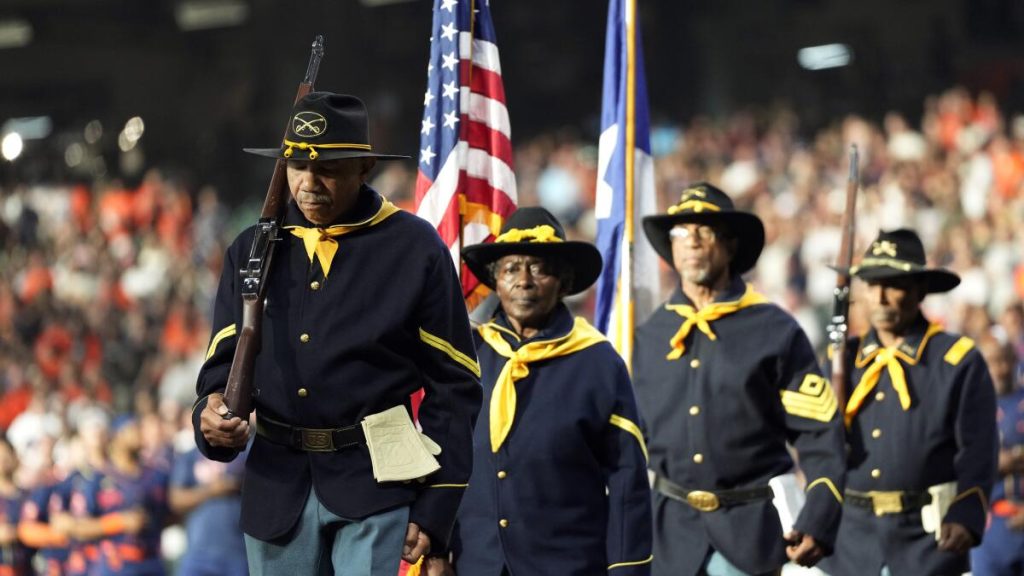
From the beginning, the Declaration’s claims have been larger than the country’s practice. The line about all men being created equal was authored by a man who held more than six hundred people in slavery. The franchise it implicitly imagined was limited in most colonies to free white men who owned property. The land it claimed had been the home of hundreds of Indigenous nations for millennia. The American tradition of reading the Declaration aloud on July 4 — common in the early Republic, revived in some communities today — is a tradition of reckoning as much as celebration; the words have always been larger than the people who wrote them, and they have always indicted the country that authored them.
For Jonathan’s Circle, Independence Day this year falls in a particularly difficult moment. Many of the people the Declaration named — and many it did not name but eventually came to include — find themselves in a year when constitutional protections they had counted on are unsettled. The Circle is a place where men of varied politics, varied histories, and varied relationships to this country can hold the day honestly. The day does not require celebration. It does ask attention to the difference between what was promised, what has been delivered, and what is still owed.
History
The Declaration of Independence emerged from a Continental Congress that had been meeting in Philadelphia since 1774. The Lee Resolution declaring independence was approved on July 2, 1776; the Declaration explaining the reasoning was approved July 4. John Adams initially expected July 2 to be the date Americans remembered, and turned out to be wrong. The signed engrossed parchment that now hangs in the National Archives was not actually signed until August 2, with additions and corrections later still. Like most foundational moments, July 4 is a composite — convenient as a symbol, less convenient as a chronology.
The franchise the Declaration imagined was narrow. In most colonies, voting was restricted to free male property holders, generally white. The Constitution that followed in 1789 protected the institution of slavery in multiple provisions, counted enslaved people as three-fifths of a person for purposes of congressional representation, and barred the new federal government from interfering with the slave trade for twenty years. Indigenous nations were treated as foreign powers when convenient and as dispossessable when not. The country whose independence the document declared was not the inclusive Republic of later rhetoric; that Republic was made — over centuries — by the labor and organizing of the people who had been excluded from it.
Frederick Douglass’s 1852 speech, “What to the Slave Is the Fourth of July?,” remains the canonical counter-text. Invited to deliver an Independence Day address in Rochester, Douglass spoke for nearly two hours. The Declaration’s principles, he said, were “saving” and “must be defended” — but the day itself, observed by white Americans while four million Black Americans remained enslaved, was “a thunder-cloud” rather than a celebration. The speech is now read aloud in many communities on July 4 alongside or instead of the Declaration. The two documents together — the founding text and the founding critique — are the more honest American observance.
Observances
Most July 4 observances are civic ritual rather than political affirmation: cookouts, family gatherings, an afternoon at the lake, fireworks in the evening. For many Americans, the day functions as a midsummer pause — the long picnic — more than as a national pageant. This is not nothing. Time with family and community, food shared outdoors, the deliberate set-aside of a workday for unhurried gathering, are observances worth keeping even when the political register of the day is uncertain.
Naturalization ceremonies on July 4 are one of the day’s more substantive observances. The federal government and many local jurisdictions schedule citizenship oath ceremonies for the holiday; thousands of new Americans take their oath each July 4. For Circle members who are immigrants, or whose families are, this is a real and ongoing observance — not the country’s self-celebration but the deliberate addition of new members to the body politic. Attending or supporting a local naturalization ceremony, where one is open to the public, is one way to mark the day.
Public readings of the Declaration and of Douglass’s speech have become an increasingly common observance in libraries, congregations, and civic associations. Some communities hold readings of additional texts: the Seneca Falls Declaration of Sentiments (1848), Martin Luther King Jr.’s 1968 “I’ve Been to the Mountaintop” speech, the original accounts of Stonewall. These readings position the day as a moment of national accounting rather than national self-congratulation.
Male Perspective
The men of the Circle hold many relationships to America. Some are descendants of people enslaved by the founders. Some are descendants of Indigenous nations whose dispossession the founders authorized. Some are first-generation immigrants whose oath of citizenship was a hard-earned threshold. Some are veterans. Some are men whose families have been here for many generations and who have voted in every election since they came of age. Some are queer men whose constitutional protections have been contested into the present. The Circle does not require any of these brothers to feel the day the same way.
For Circle members whose communities the Declaration did not originally name — Black brothers, Indigenous brothers, queer brothers, brothers without property, brothers whose families were not free in 1776 — the day has always required negotiation. The Black tradition of observing Juneteenth (June 19) as the more honest American freedom day is well established. The queer tradition of marking Pride (June) and Stonewall (late June) as the foundational dates of contemporary liberation is now part of the broader American calendar. July 4 is one date among several; it is the most heavily promoted but not necessarily the most personally meaningful.
For straight Circle members whose families benefited from the limited franchise — including most descendants of white European immigrants — the day is one for honest accounting. The American Republic that emerged from 1776 was made for some at the expense of others; the present moment is one in which that asymmetry is being relitigated in real time. The Circle’s commitment to widening the circle of “we” is the work the day actually asks of us, more than fireworks. The honest observance is in the next conversation, the next vote, the next time you stand up for a brother whose constitutional standing is being narrowed by people in power.
A practical observance: read Frederick Douglass’s 1852 speech this week — to yourself, to a partner, to whoever will sit through it. Spend time with the people in your life who carry the long-picnic tradition forward; share the food, take the afternoon. If a public naturalization ceremony is happening near you, attend if you can; the new Americans there are part of the country we are still making. And — without polemic, without performance — name to yourself what you are grateful for and what you are working to repair. Both matter.
Summary
US Independence Day invites honest reckoning more than reflex pageantry — with what was promised, what has been delivered, what is still owed, and the many relationships the men of the Circle hold to a country that is still being made.