
- Shavuot
Overview
Shavuot, also called the Feast of Weeks, is a major Jewish festival that commemorates the giving of the Torah to Moses on Mount Sinai. It falls on the sixth of Sivan in the Hebrew calendar — fifty days after the second night of Passover — and in 2026 begins at sundown on Sunday, May 31, ending at nightfall on Tuesday, June 2 in the Diaspora (a one-day observance in Israel).
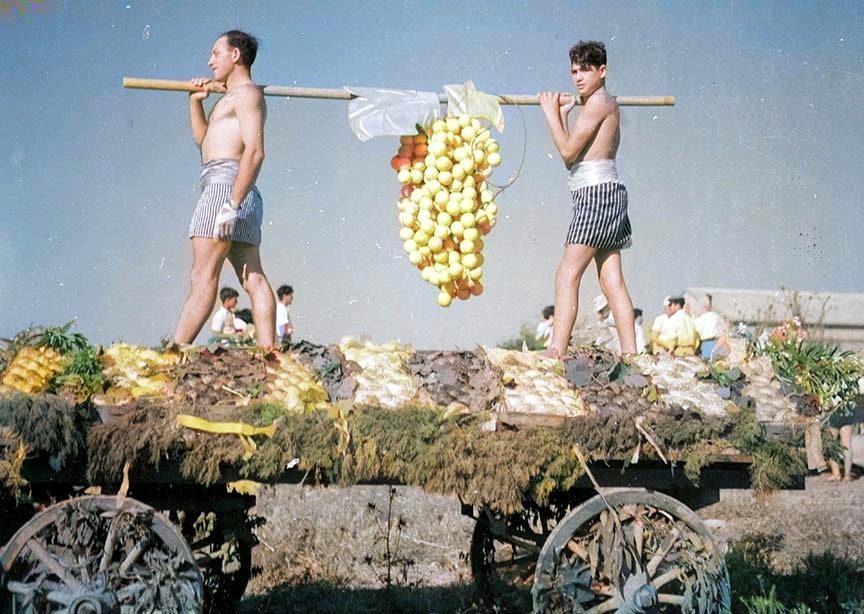
Shavuot is one of the three pilgrimage festivals of biblical Judaism, alongside Passover and Sukkot. In ancient times Jews traveled to Jerusalem for these festivals; the festival also marked the offering of the first fruits of the spring harvest at the Temple. With the destruction of the Second Temple in 70 CE, the agricultural and pilgrimage dimensions receded and the festival’s primary meaning consolidated around the giving of the Torah at Sinai.
For gay men engaging with Shavuot — whether Jewish or not — the festival has a particular resonance. It commemorates the moment a people received the words by which they would understand themselves and their relationship to the holy. The question of which words form us, and how we receive them, is one every spiritually serious gay man has had to ask.
History
The festival’s biblical origins are agricultural. The Hebrew Bible (Leviticus 23, Deuteronomy 16) commands the counting of seven weeks from the day the omer of barley was offered during Passover — a period now called the Counting of the Omer. On the fiftieth day, a new offering of wheat was to be made, along with two leavened loaves baked from the new wheat. The festival was called Shavuot (Weeks) for the seven weeks counted; it was also called the Feast of Harvest and the Day of First Fruits.
The biblical text does not explicitly link Shavuot to the giving of the Torah. That association developed in the rabbinic period, after the Temple’s destruction. The rabbis calculated, based on the biblical chronology, that the Israelites arrived at Mount Sinai approximately three months after the Exodus from Egypt. By a process of further calculation, the giving of the Torah was placed on the sixth of Sivan — the date of Shavuot. This rabbinic identification, recorded in the Talmud, has been the festival’s dominant theme for nearly two thousand years.
The festival’s observance has evolved through Jewish history. The medieval mystics of Safed in the sixteenth century developed the practice of Tikkun Leil Shavuot — an all-night study session on the eve of the festival. The kabbalists understood the night as a kind of preparation, a wedding night between Israel and the Torah, in which staying awake to study was an act of devoted attentiveness. The custom spread widely through Jewish communities and remains one of the most distinctive features of Shavuot observance to the present day.
In modern Jewish life, Shavuot has become the customary occasion for Confirmation in many Reform and Conservative congregations — the ceremony marking older teenagers’ deeper commitment to Jewish life and learning. The connection is appropriate: a festival of receiving the Torah is a fitting context for younger Jews to mark their adult engagement with that tradition.
Shavuot has historically been a less prominent festival than Passover or the High Holidays in popular Jewish observance, perhaps because it lacks the dramatic narrative structure of those holidays. There is no Seder, no shofar, no fasting. But it has had a quiet, sustained presence and has, in recent decades, seen something of a revival as contemporary Jewish communities have given more serious attention to study, learning, and intellectual engagement with tradition.
Observances
The most distinctive observance of Shavuot is Tikkun Leil Shavuot — the all-night study session on the festival’s first evening. Synagogues organize study sessions that may run from after the evening meal until dawn, with rotating teachers, classes on Torah and Talmud and Jewish thought, and breaks for tea and cake. The point is sustained collective study; the content varies enormously by community. Some Tikkun sessions are highly traditional, focused on classical text study; others are more eclectic, with classes on Jewish poetry, contemporary Jewish theology, or Jewish ritual practice. At dawn the participants pray the morning service and disperse for sleep.
In synagogue services on the festival itself, the Torah reading is the Decalogue — the Ten Commandments — read with particular ceremony. The congregation stands as the words are read. In some traditions, children are particularly honored on Shavuot; in some communities, very young children are formally introduced to Torah study on the festival, sometimes by being given honey to taste with the alphabet to associate the sweetness of learning with the words themselves.
The Book of Ruth is traditionally read during the festival. The book’s setting is the spring harvest — placing it naturally within Shavuot’s agricultural origins — and its central narrative of Ruth’s commitment to Naomi (“whither thou goest, I will go”) is read as a paradigm of the convert’s relationship to Judaism: a deliberate, loving choice to receive the tradition.
Dairy foods are a strong Shavuot tradition. Cheesecake, blintzes, kugel, and other dairy dishes appear on Shavuot tables across the Jewish world. The custom’s origins are debated; explanations include the comparison of Torah to milk and honey, the biblical phrase land of milk and honey describing the Promised Land, the dietary considerations involved in the Israelites receiving the kosher laws at Sinai (which would have rendered their meat instantaneously non-kosher), and various numerological associations. Whatever the origin, Shavuot is the unofficial cheesecake festival of the Jewish year, and that is no small thing.
Synagogues are often decorated with greenery and flowers for Shavuot — a tradition rooted both in the festival’s agricultural origins and in the rabbinic image of Mount Sinai itself blooming when the Torah was given. The visual is reliably beautiful, and the smell of fresh flowers and greens carries the festival.
Male Perspective
For Jewish Circle members — and particularly for gay Jewish men — Shavuot has had a complicated and increasingly hopeful history across the past several decades. The festival commemorates the giving of the Torah, and the Torah contains, among many other things, the Levitical prohibitions traditionally read as condemning male same-sex intimacy. To celebrate the receiving of those words while being a man whose love those words have been used against is, for gay Jewish men, the central tension of their religious lives. The Circle holds that tension with the respect it deserves.
The serious work of Jewish theology and Torah study around homosexuality has, in the past forty years, transformed the conversation. Reform, Reconstructionist, Renewal, and most Conservative communities now ordain openly gay rabbis and consecrate same-sex Jewish marriages. The Modern Orthodox conversation has been quieter and slower but has produced its own significant body of work and a growing community of openly gay observant Jews. The Torah’s treatment of male same-sex intimacy is, in this contemporary work, no longer simply read as a flat prohibition; it is engaged with the full sophistication that Jewish tradition brings to its hardest texts. That work is itself a Shavuot kind of practice — the ongoing receiving of the Torah, the willingness to study its words seriously rather than to reject them, the refusal to be satisfied with the simplest reading. It is the same kind of work that other Jewish men have done over many generations on other hard questions the tradition has put to them, and Shavuot honors all of it.
The all-night study practice of Tikkun Leil Shavuot has, in many inclusive communities, become a particularly meaningful custom. Synagogues with significant LGBTQ+ membership often offer classes during the night specifically on the Jewish queer encounter with tradition — the work of writers like Rebecca Alpert, Steven Greenberg, Joy Ladin, and many others. Staying up through the night to study the texts that have been used against you, in community with men and women who are doing the same work, is a quietly powerful act of love for one’s own tradition. For Jewish men whose particular hard texts run in different directions — around interfaith marriage, around modernity, around the questions of Israel, around any of the issues that contemporary Judaism has had to wrestle through — Tikkun Leil Shavuot offers the same kind of patient communal study.
For Circle members who are not Jewish, Shavuot still has things to offer. The festival’s deepest theme — the receiving of words by which to organize a life — is universal. Every man eventually faces the question of which words he will accept as authoritative for himself, and which he will refuse. The texts that have shaped each of us — sacred or secular, family or cultural — came to us through some equivalent of Sinai, some moment of formation in which we received the language we now speak. Shavuot honors that process. It also honors the work of choosing which words we will pass on.
A simple practice for the festival: read something serious. Choose a text that has shaped you — religious, philosophical, literary, scientific — and spend a sustained period with it. Underline what still rings true. Mark what you no longer believe. The act of patient engagement with formative words is the festival’s deepest practice. The cheesecake is, of course, also recommended.
Summary
Shavuot is a feast of covenant, revelation, and the sweetness of wisdom received. In its all-night vigil and harvest joy, it holds together the earthy and the transcendent.
Date: May 31–June 2, 2026 (begins at sunset May 31)