
- Ascension Thursday
Overview
Ascension Thursday, also called the Feast of the Ascension, commemorates the bodily ascent of Jesus Christ into heaven forty days after his resurrection. It is one of the great feasts of the Christian liturgical year, celebrated by Catholics, Orthodox, Anglicans, and many Protestant denominations. The date moves with Easter; in 2026 it falls on Thursday, May 14.
The feast marks the conclusion of Christ’s post-resurrection appearances to his disciples and the beginning of the nine days of waiting before Pentecost, when the Holy Spirit descended upon the gathered community. In some Western traditions the feast has been transferred to the following Sunday for ease of attendance, but the original observance remains a Thursday — the fortieth day inclusive from Easter Sunday — in keeping with the chronology given in the Acts of the Apostles.
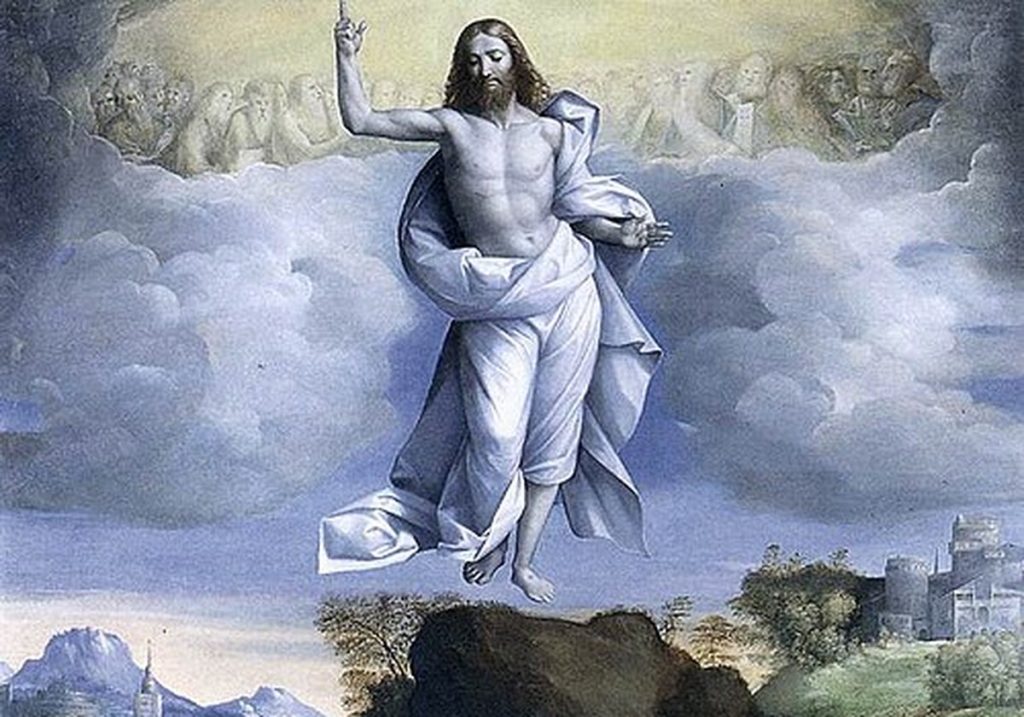
Ascension is, for those who keep it, both an ending and a threshold. It closes the visible presence of Christ on earth and opens the season of the Church’s own becoming.
History
The biblical account of the Ascension appears in the first chapter of the Acts of the Apostles and in the closing verses of the Gospel of Luke. Forty days after the resurrection, Jesus gathers his disciples on the Mount of Olives near Bethany, blesses them, and is taken up into the sky as they watch. Two figures in white — angelic messengers — then ask the disciples why they stand staring upward, and tell them that Jesus will return in the same way they have seen him go.
The feast was observed from at least the fourth century. Augustine of Hippo, writing around 400 CE, refers to it as a universal Christian observance with apostolic origins, suggesting that by his lifetime the celebration was already very old. The forty-day count is theologically charged: it echoes the forty days Moses spent on Sinai, the forty years of Israel in the wilderness, and the forty days Christ himself spent fasting in the desert before his public ministry. In Christian numerology, forty is a span of preparation and transition.
In medieval Europe, Ascension Day became one of the great processional feasts. Crucifers carried the cross outside the church and into the surrounding fields, blessing crops and asking God’s protection on the year’s growth. In England the day was sometimes called Holy Thursday — a name later transferred to the Thursday of Holy Week. Beating the bounds, an English custom of walking the parish boundary and reciting prayers at each marker, was traditionally performed in Rogation week, the days immediately before Ascension. The walking of bounds combined civic and spiritual function: it taught children the parish geography while invoking divine protection over the community.
The Reformation reshaped Ascension observance unevenly. Lutheran and Anglican churches retained it as a major feast. Most Reformed Protestant traditions de-emphasized it, though many continue to mark it. In contemporary Catholic practice, the feast is a Holy Day of Obligation in many countries; in others, including most U.S. dioceses, the obligation has been transferred to the following Sunday.
Observances
Ascension Thursday is most visibly observed in liturgical churches — Catholic, Orthodox, Anglican, and Lutheran — with a special Mass or Eucharistic service. The Gospel reading is the Ascension narrative; the homily often draws out the dual themes of departure and commission. In many parishes the Paschal candle, lit at the Easter vigil and burning through the season of resurrection, is extinguished after the Gospel on Ascension as a visible sign that the visible presence of Christ has departed.
In Catholic and Orthodox traditions, the feast inaugurates a nine-day period of waiting and prayer leading to Pentecost. This is the original novena — the nine days the disciples gathered in the upper room with Mary, praying for the coming of the Spirit. Many parishes pray a Pentecost novena during this stretch, asking for the gifts of the Holy Spirit. The Ascension-to-Pentecost interval is one of the few extended periods of focused waiting in the Christian calendar.
Beyond the formal liturgy, customs vary widely by region. In parts of Germany, the day coincides with Männertag or Vatertag (Father’s Day) and is marked by hiking and outdoor gatherings, often quite secular. In England, beating the bounds processions still occur in some traditional parishes. In rural Catholic Europe, blessings of fields and gardens at Ascension survive in pockets. In Eastern Orthodoxy, the feast carries forward an extended celebration with its own afterfeast running into the following days.
For those without a liturgical community, Ascension can still be marked privately: by reading the Acts and Luke accounts, by walking outdoors and noticing what is rising in the season — sap, birds, light — and by entering into the nine days of waiting that follow. The feast invites a particular kind of attention: looking up, but not staying there.
Male Perspective
For Christian men in the Circle, Ascension carries a quiet theological gift. The feast affirms the bodily ascent of Christ — not just his soul, but his risen body, scarred and human, taken into the eternal life of God. The implication is that bodies belong in heaven; that the flesh, including the male flesh that has known both wound and pleasure, is gathered up into the divine. For men who grew up in traditions that taught the body was an obstacle to holiness, this is no small claim. Ascension says: the body goes home.
The Ascension also marks the beginning of the Church’s own work. The two figures in white ask the disciples, in effect, why they are still looking up. The instruction is to come down off the mountain, return to the city, and wait for what the Spirit will give them to do. For Circle members in the Christian tradition — especially those whose presence in their churches has been contested for any reason — the ascension narrative refuses passivity. The feast does not let us linger in nostalgia for an idealized Christ; it sends us back to the work of building community in his absence and his Spirit.
For men in Jonathan’s Circle who are not Christian, Ascension can still be approached as a meditation on departure and presence. Every relationship of love eventually contains an ascension — a leaving of one form so that another can begin. The lover who dies, the parent who passes, the friend who moves away, the part of ourselves we must let go to become the next version of who we are. The feast offers a vocabulary for those losses and the patient waiting that follows them.
The nine-day stretch from Ascension to Pentecost is, for many Circle members, the most useful part of the cycle. It teaches the spiritual discipline of waiting in absence — not the bright presence of Easter, not yet the fire of Pentecost, but the in-between, the tender quiet, the not-yet. For any man who has spent long stretches in waiting rooms of various kinds — waiting for diagnosis, for resolution, for clarity, for the next chapter to reveal itself — these nine days name a holy use for that experience. We are not abandoned. We are gathered, and we wait together.
Summary
Ascension Thursday is a feast of holy departure, embodied eternity, and the necessary threshold between what was and what is coming.
Date: May 14, 2026 (40 days after Easter)