
- Vesak / Buddha Day
Overview
Vesak — also called Buddha Day, Buddha Purnima, Wesak, or simply Buddha’s Birthday — is the most important holiday in the Buddhist calendar. It commemorates the birth, enlightenment, and parinirvana (death) of Siddhartha Gautama, the historical Buddha. According to tradition, all three events occurred on the same calendar date in different years, on the full-moon day of the lunar month Vaisakha. In 2026 the festival falls on Monday, May 11 in most Theravada traditions; some Mahayana traditions observe it on slightly different dates.
Vesak is observed across the Buddhist world — from Sri Lanka, Thailand, Myanmar, Cambodia, and Laos in the Theravada south, to China, Korea, Japan, Vietnam, and Tibet in the Mahayana and Vajrayana north — with significant variations in custom and emphasis. The United Nations recognized Vesak as an international observance in 1999, acknowledging the contribution of Buddhism to global culture.
For gay men engaging with Buddhist practice or curiosity, Vesak is an unusually accessible entry point. The festival’s themes — the cycle of birth, awakening, and the end of suffering; the value of meditation; compassion as a discipline rather than a feeling — ask very little doctrinal commitment and offer significant useful practice.
History
The historical Buddha was born Siddhartha Gautama, son of a regional king in what is now southern Nepal, sometime between the sixth and fourth centuries BCE — the precise dates remain debated by historians. According to tradition, he was raised in royal seclusion, married, fathered a son, and at the age of twenty-nine encountered the Four Sights that determined his life: an old man, a sick man, a corpse, and a wandering ascetic. The first three taught him that suffering was unavoidable in human life. The fourth showed him that some had chosen to seek a way through it.
He left his palace, his wife, and his son, and spent years studying with various spiritual teachers and practicing severe ascetic disciplines that brought him near death without bringing the understanding he sought. He eventually rejected extreme asceticism, took a meal of rice and milk, and sat down beneath a tree at Bodh Gaya. Through the night he sat in meditation. By dawn, according to tradition, he had attained enlightenment — a complete understanding of the nature of suffering and its end. He was thirty-five years old. The tree under which he sat became known as the Bodhi tree, and a descendant of that original tree still stands at Bodh Gaya, one of the most visited pilgrimage sites in the Buddhist world.
For the next forty-five years he taught. He gathered a community of disciples (the sangha) and articulated the body of teaching that became Buddhism: the Four Noble Truths (suffering exists, suffering has a cause, suffering can end, there is a path to its ending), the Eightfold Path (right view, right intention, right speech, right action, right livelihood, right effort, right mindfulness, right concentration), and the many other teachings that have been preserved and elaborated across the centuries. He died at the age of eighty in Kushinagar, in northern India, lying on his right side between two sal trees — the position depicted in the parinirvana statues found across the Buddhist world.
The observance of Vesak is ancient and was unified across Theravada Buddhism by a 1950 conference of the World Fellowship of Buddhists in Sri Lanka, which set the full-moon day of Vaisakha as the standard date. Mahayana traditions in East Asia have older, sometimes different conventions — in Japan and Korea the Buddha’s birthday is often observed on April 8 (Hanamatsuri or Bucheonim Osin Nal), distinct from the festival’s observance in Theravada countries. Tibetan Buddhism observes Saga Dawa, a month-long observance with the full-moon day at its center.
Observances
Vesak observances vary significantly by tradition and region but share certain common elements. Buddhists visit temples to chant, meditate, and listen to sermons. Many take the opportunity to renew the Five Precepts (refraining from killing, stealing, sexual misconduct, false speech, and intoxicants), the basic ethical commitments of lay Buddhism. Some lay practitioners take the Eight Precepts — a more rigorous observance traditionally taken on full-moon days — for the duration of the festival.
In Theravada countries (Sri Lanka, Thailand, Myanmar, Cambodia, Laos), Vesak observances are often quite elaborate. Temples are decorated with lanterns, flags, and flowers. Public alms-giving — dana — is widespread, with laypeople offering food and other necessities to monks and to the poor. Many people release captive birds or animals as a symbolic act of compassion (a practice some Buddhist ethicists have begun to question because of the broader ecological harms of the captive-animal trade). Processions of devotees walk to temples carrying offerings.
In Sri Lanka particularly, Vesak is marked by elaborate decorative lanterns (vesak kuduwa) hung outside homes and businesses, free food stalls (dansala) set up by lay devotees to feed all comers regardless of religion, and public dramatic enactments of stories from the Buddha’s life. Whole neighborhoods are decorated, and the night of the full moon is one of the visually striking nights of the Sri Lankan year.
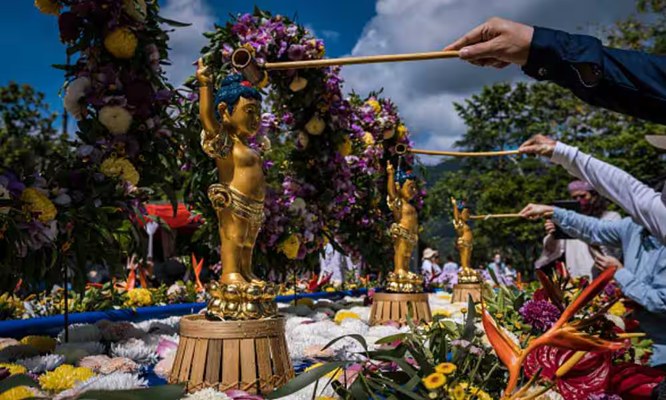
In Mahayana traditions, the observance often centers on the Bathing of the Buddha ceremony, in which a small statue of the infant Buddha is placed in a basin and water (or fragrant tea) is poured over it by each devotee in turn. The act symbolizes the cleansing of one’s own mind and the honoring of the Buddha’s birth.
For non-Buddhists or for those whose Buddhist practice is informal, Vesak can be observed simply: by sitting in meditation, by reading a Buddhist text (the Dhammapada is short, accessible, and central), by performing some act of generosity, by abstaining from intoxicants and harmful speech for the day, by visiting a Buddhist temple if one is accessible (most welcome respectful visitors on the festival).
Many Buddhist communities use Vesak as a day of charity, with temples organizing food distributions, blood drives, and other public-good events. The festival’s emphasis on compassion as practical action gives it a different character from many religious holidays — less about belief, more about observed conduct on a single day that is supposed to model a longer practice.
Male Perspective
Buddhism has a distinctive ethical posture that sets it apart from most of the major religious traditions in its dealings with sexuality. The Buddhist ethical framework, in its classical form, addresses sexual misconduct in terms of harm — the use of sexuality to cause suffering to oneself or others — rather than in terms of the gender of the people involved. Many contemporary Buddhist teachers, including the Dalai Lama on multiple occasions, have explicitly affirmed gay relationships as fully compatible with Buddhist practice when conducted with love, fidelity, and respect, alongside the broader teaching that any man’s sexual life is to be evaluated by whether it produces harm or not.
This is not to say Buddhist cultures have been uniformly accepting of any particular configuration of sexuality or family. The histories of homosexuality, of polygamy, of monasticism, of celibate practice, and of ordinary householder marriage in Theravada countries, in China, Japan, Korea, and Tibet are complicated and uneven. But the tradition’s own ethical core has not generated the kind of detailed sexual condemnations that mark some other traditions, and Circle members of any orientation engaging with Buddhism rarely have to fight their tradition for permission to exist. They more often simply have to do the actual practice.
And the practice is the gift. The Buddhist analysis of suffering — dukkha — names with extraordinary precision a kind of ordinary unhappiness that most men have spent significant portions of their lives inside. The dissatisfaction that does not go away when desire is fulfilled, the comparison and longing that fuels much of contemporary culture, the persistent low-grade ache of feeling oneself not quite at home anywhere — these are not specific to any one orientation or family configuration; they are part of the human condition, and Buddhist practice has remarkably useful things to say about them. Meditation, in the Buddhist analysis, is the discipline that gradually allows a person to see the working of suffering in his own mind clearly enough that it begins to release its grip.
For Circle members specifically, the Buddhist tradition offers practical resources that can sit alongside whatever other spiritual commitments are present. Mindful breathing, body-scan meditation, the loving-kindness practice (metta) of explicitly extending good will to oneself, to those one loves, to neutral parties, to those who have caused harm — these are practices any man can take up without doctrinal commitment. They tend, when practiced sustainably over months and years, to produce noticeable shifts in how the man’s own mind operates.
A simple practice for Vesak: sit in silence for thirty minutes. Watch the breath. When the mind wanders — it will — return gently to the breath without reproach. After the sitting, perform one act of compassionate generosity that costs you something: a substantial donation to a charity, an apology genuinely owed, a phone call to a person you have been avoiding, a true act of care for your own body. The day is asking very little. It is asking only that, for one day, you treat your own mind as worth the discipline and your own conduct as worth the attention.
Summary
Vesak is a day that honors the audacious possibility at the heart of Buddhism: that any human being — including any man — can wake up. It is a feast day for the inner life.
Date: May 11, 2026 (full moon of Vaisakha)