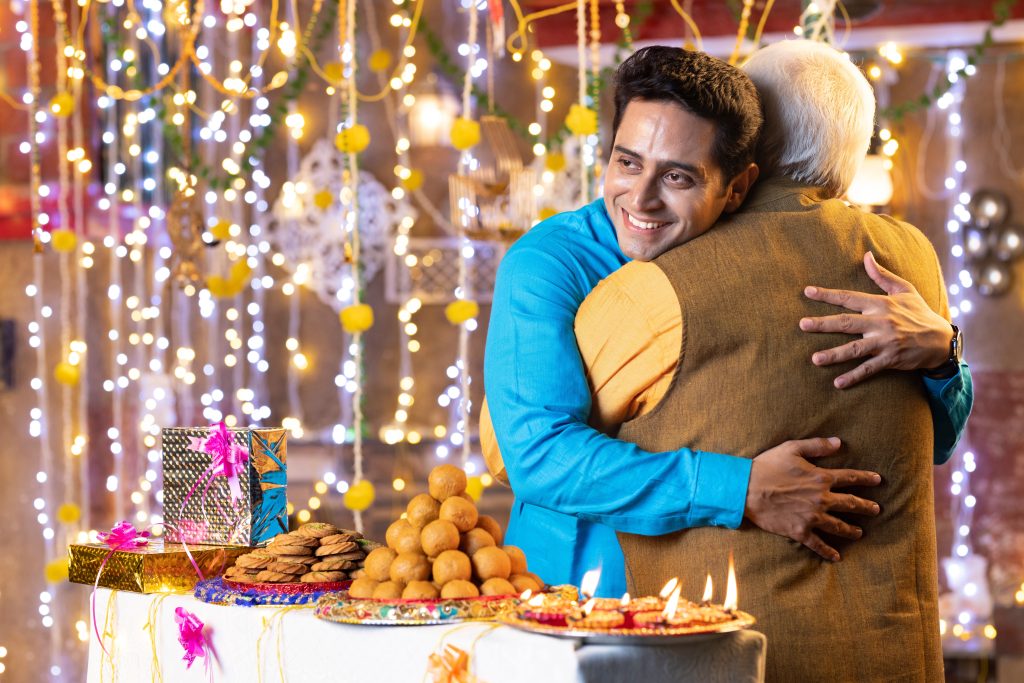
For a men’s community whose October theme was Celebrating Light and Darkness, Diwali arrives with a perfect echo. It is a different tradition’s version of the same deep human intuition: that at the dark half of the year, we gather, light small flames, and insist that the light will not be extinguished.
History
Diwali’s origins reach into pre-history and vary across the traditions that celebrate it. For most Hindus, the central story is the return of Lord Rama, his wife Sita, and his brother Lakshmana to the city of Ayodhya after fourteen years of exile and after Rama’s victory over the demon-king Ravana — the great story of the Ramayana. The people of Ayodhya lit rows of oil lamps to welcome them home. That lighting of the lamps became Diwali.
Other Hindu traditions associate Diwali with Lakshmi, the goddess of prosperity and wellbeing, who is understood to visit well-kept, well-lit homes on the central night of the festival. In South India, the holiday is often tied to the story of Krishna defeating the demon Narakasura. For Jains, Diwali marks the attainment of moksha (liberation) by Lord Mahavira in 527 BCE. For Sikhs, the festival coincides with Bandi Chhor Divas — the day in 1619 when the sixth Guru, Guru Hargobind, was released from imprisonment by the Mughal emperor Jahangir, insisting that fifty-two Hindu princes be released alongside him.
What all of these stories share is the arc that gives the holiday its character: a long darkness, a victory of righteousness or liberation, and a homecoming marked by the lighting of lamps.
Observances
The five days of Diwali follow a traditional sequence. The first day, Dhanteras, is dedicated to prosperity and the purchase of new household items. The second day, Naraka Chaturdashi (also called Choti Diwali), marks Krishna’s defeat of Narakasura. The third day is Diwali itself — the main night of the festival, when homes are at their brightest, families gather, and the goddess Lakshmi is invited into every well-kept home. The fourth day, Govardhan Puja, marks Krishna’s lifting of Mount Govardhan to shelter his village from the rains. The fifth day, Bhai Dooj, celebrates the bond between brothers and sisters.
Across all five days, common practices include the lighting of diyas and strings of electric lights; the drawing of rangoli — intricate patterns in colored powder, flour, or flower petals — at the thresholds of homes; family meals featuring sweets (ladoos, barfi, jalebi) and savory snacks; the exchange of gifts; new clothes for the family; and fireworks that light the night sky.
A private observance can be as simple as lighting a few candles or diyas on the night of November 8, naming what in your life has moved from darkness toward light this year, and sharing something sweet.
Male Perspective
Diwali is one of the great festivals of the world, and Jonathan’s Circle is a brotherhood of men of every orientation and gender identity. For a Circle whose October theme named the honest reckoning with darkness and light at the center of the year, Diwali arrives as a kindred observance from another tradition.
For brothers of Indian and South Asian descent in the Circle, Diwali is home. Whatever form your Diwali takes this year — a diya on the sill, a visit with family, a rangoli at the threshold, sweets shared with neighbors, the quieter observance of a brother living far from home — the Circle is glad you are among us, and grateful for what the tradition you carry gives all of us.
For every other brother, the invitation is to notice the day. The lighting of a diya on November 8 is a small, meaningful act of recognition — of a tradition older than most of what we were taught in school, and of the brothers in our own community who are gathering around the world on the same night.
Diwali also carries a long and quietly beautiful queer thread. The Mahabharata and other classical Hindu texts contain figures who move across gender; the god Ardhanarishvara is depicted as half Shiva and half Parvati, male and female combined in one body. Hindu LGBTQ+ scholars like Devdutt Pattanaik have been recovering this tradition for a wider audience over the past two decades, and South Asian LGBTQ+ organizations around the world now host Diwali gatherings specifically for queer South Asians and their chosen families — Sangat (Chicago), SALGA (New York), Trikone (San Francisco), Satrang (Los Angeles), DesiQ (Toronto), and others. These gatherings are often the one Diwali of the year that queer South Asians can celebrate without having to leave part of themselves at the door.
For every brother in the Circle, the deepest meaning of Diwali is one every tradition recognizes: that at the dark half of the year, we gather, we light small flames, and we insist that the light will not be extinguished.
Summary
Diwali is the festival of lights, celebrated across Hindu, Sikh, Jain, and some Buddhist traditions as the victory of light over darkness. For the men of Jonathan’s Circle — and particularly for brothers of South Asian descent — the central night of Diwali, November 8 this year, is a chance to light a diya, name what in us has turned toward the light, and join a tradition that has been keeping this exact faith for several thousand years.