History
Halloween’s oldest layer is the pre-Christian Celtic festival of Samhain (SOW-in), observed from sundown October 31 through November 1 by the Gaelic peoples of Ireland, Scotland, and the Isle of Man. Samhain marked the end of the harvest and the beginning of winter — the darker half of the year. It was one of two nights (Beltane was the other) when the veil between the world of the living and the world of the aos sí — the spirits and ancestors — was believed to be thin. Bonfires were lit, animals were slaughtered for winter stores, and food and drink were set out for wandering spirits.
When Christian missionaries reached the Celtic lands, they did not so much erase these observances as absorb them. The feast of All Saints — All Hallows — moved from May to November 1 by the mid-eighth century, and All Souls’ Day settled on November 2. The three days together — October 31, November 1, November 2 — became Allhallowtide, a season for honoring saints, souls, and the beloved dead. Practices flowed between the two traditions: souling (going door to door for soul cakes in exchange for prayers for the dead) is a medieval Christian ancestor of modern trick-or-treating; guising (going in costume, often with a lantern) traces back to the Celtic festival.
Irish and Scottish immigrants brought their Halloween customs to North America in the nineteenth century, and the holiday was thoroughly re-shaped by twentieth-century American commerce — mass-produced costumes, candy, and horror films made it the multi-billion-dollar observance it is today.
Observances
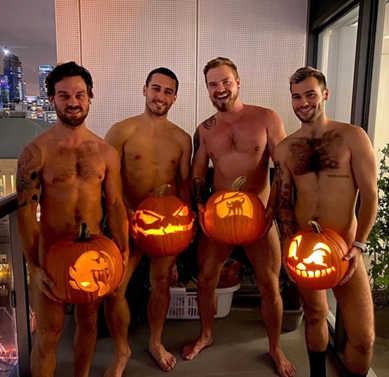
The night is now marked by trick-or-treating, costume parties, jack-o’-lantern carving, haunted attractions, and horror-film marathons. Neighborhoods where children still roam door to door in costume have become somewhat rarer than a generation ago, but the impulse behind the practice remains: dressing up, becoming someone else, being welcomed at strangers’ doors, receiving small offerings.
For adults, the Halloween party has become a fixture — a night for elaborate costume, for going out in a version of oneself that would not walk down the street on any other night of the year. In queer communities in particular, Halloween has been called “the gay Christmas” for as long as anyone can remember: a night of drag, camp, gender play, and community that predated the wider culture’s embrace of any of it. The Castro Street Halloween in San Francisco, the Greenwich Village Halloween Parade in New York, the Halloween block parties in West Hollywood and Wilton Manors — these have been the queer community’s high holy nights for decades.
For a spiritual observance, some traditions keep a version of the old bonfire practice — a small fire, a name spoken aloud, a moment of silence for the dead. Others read poetry appropriate to the night: John Donne, Mary Oliver, Lucille Clifton. Some simply eat well, tell true stories, and let the veil be thin.
Male Perspective
For gay, bisexual, and queer men in particular, Halloween has offered something no other night on the calendar does. It has been the night when the closet cracked open a little, when clothes and gestures and desires that had to stay hidden the other 364 nights could walk freely. Generations of us have first tasted our own reflection in a Halloween mirror — the drag we wore, the leather we put on, the pair of angel wings we bought on impulse and could not part with. For elders in the community, the story of coming out is often bound up with a specific Halloween.
The night also carries our dead. The AIDS years mean that many of our beloved brothers are on the other side of the veil now, and Halloween — with its ancient permission to feel their presence — is a night many gay men have quietly turned into a private All Souls’. A photograph on the mantel, a candle lit, a name spoken. That is a Circle-appropriate way to end the evening after the party.
Summary
Halloween is layered and old — Celtic, Christian, commercial, camp — and it is one of the most quietly spiritual nights on the modern calendar. It is a night to play, to remember, and to let the boundaries between selves and worlds be a little thinner than usual. For the men of Jonathan’s Circle, October 31 is a night for costume and communion, and for the beloved dead who are never far.