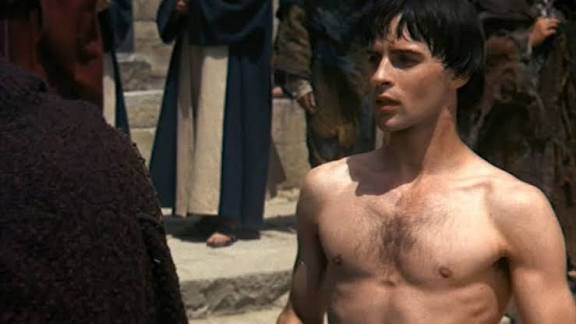
For a men’s community concerned with body, spirit, and the integration of the two, Francis offers a rare and generous companion. He refused the split.
History
Giovanni di Pietro di Bernardone was born around 1181 in Assisi, in the Umbrian hills of central Italy. His father was a prosperous cloth merchant; the family had money and social standing, and Giovanni — nicknamed Francesco, “the little Frenchman,” for his mother’s origins — was expected to inherit both. He spent his youth as a wealthy young reveler, then as a soldier, until a period of imprisonment, illness, and vision turned his life inside out. In 1206, in front of the bishop of Assisi and a crowd in the piazza, he stripped off his clothes, handed them back to his father, and walked out naked — renouncing family wealth, social position, and inherited identity all in a single public act.
He spent the rest of his life in what he called Lady Poverty — begging, rebuilding ruined churches with his own hands, tending lepers, and gathering companions who wanted the same simple, radical freedom. The Order of Friars Minor, or Franciscans, grew from that band. In 1224, on Mount La Verna, Francis received the stigmata — the visible marks of Christ’s crucifixion in his own hands, feet, and side. He died two years later on October 3, 1226, and was canonized within two years — one of the fastest paths to sainthood in Church history. Pope Pius XII named him the patron of Italy in 1939; Pope John Paul II named him the patron of ecologists in 1979.
Observances
October 4 is marked in parishes and cathedrals around the world with the Blessing of the Animals, a service in which pets, farm animals, and sometimes exotic guests are brought forward to receive a prayer. It is one of the tenderest liturgies of the Christian year — dogs and cats, parrots and iguanas, horses and goats all standing patiently while the priest lays a hand on each in turn. Franciscan communities keep vigil the night of October 3 with the Transitus, a liturgy that walks with Francis through his final hours.
Beyond the Church, the day is now widely observed as an ecology feast. Interfaith services, Earth blessings, and community garden dedications are common. Some communities read Francis’s Canticle of the Creatures — the poem in which he praises “Brother Sun,” “Sister Moon,” “Brother Wind,” and even “Sister Death.” For a men’s spirituality circle, October 4 is an inviting date for an outdoor liturgy, a shared meal with the earth’s food front and center, or a group reflection on what we would strip off in a piazza today if we had the courage he had.
Male Perspective
Francis has been quietly claimed by generations of queer men — and not without reason. He refused to be who his father wanted him to be. He kissed a leper on the road and felt his revulsion turn to sweetness. He preferred the company of Brother Leo, his beloved companion, above almost all others. He wrote poetry to the elements and named the moon his sister. He walked barefoot and half-clothed through the Italian countryside, unashamed of a body that was, at the end, marked by love. Whether or not the historical Francis fits any modern label, his path — away from inherited masculinity, toward tenderness and creation — is one many gay, bisexual, and queer men have walked in some form of our own.
There is also his refusal of the split we so often carry. Body and spirit, flesh and soul, eros and prayer — for Francis these were not opposed. The sun on his face, the crust of bread in his hand, the wounds in his side: all of it, together, was God’s. The Circle’s language of erotic spirit has a genuine forefather in the little poor man of Assisi.
Summary
The Feast of St. Francis is a doorway into a spirituality that refuses to divide creation from Creator, or body from soul. On October 4 we remember a man who left his father’s house naked, embraced a leper, kissed the earth, and welcomed even his own death as a sister. For the men of Jonathan’s Circle, he is a good ancestor to sit with — a saint of tender bodies and open hands.