History
The tradition of Thanksgiving in what is now Canada is older than the American observance. In 1578, the English explorer Martin Frobisher held a formal thanksgiving ceremony in what is now Nunavut, giving thanks for the safe passage of his fleet. Samuel de Champlain and the French settlers of Port-Royal held their own thanksgiving feasts in the early 1600s, sometimes with Mi’kmaq guests. The tradition remained irregular and local for centuries — sometimes tied to military victories, sometimes to harvest, sometimes to royal occasions.
Parliament first designated a national Thanksgiving in 1879. The date moved around considerably in the following decades — from mid-November to early October to almost anywhere in between — before settling in 1957 on the second Monday of October. The reasoning was practical: an earlier date fit the actual timing of the Canadian harvest, and it kept the observance clear of Remembrance Day (November 11), which had grown into a solemn national moment of its own.
Today Canadian Thanksgiving is a statutory holiday in most provinces, though not in the Atlantic provinces of New Brunswick, Nova Scotia, and Prince Edward Island. The three-day weekend it creates is one of the season’s most beloved: leaves at peak, cottage country still open, families gathering before the long winter.
Observances
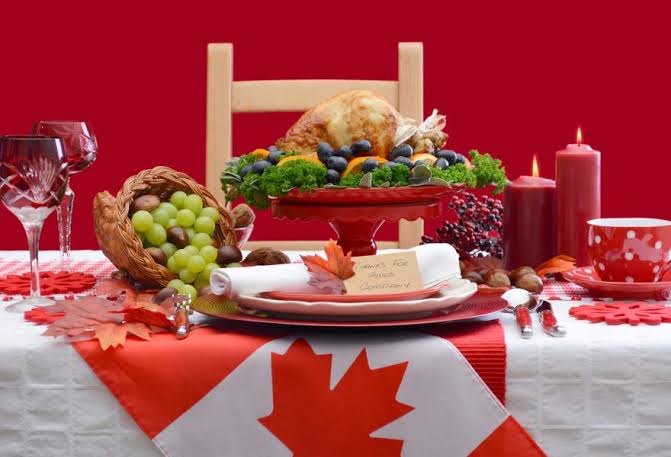
Canadian Thanksgiving looks in many ways like its American cousin. Roast turkey with stuffing is the classic centerpiece; ham and roast goose are common in some regions. Root vegetables — squash, potatoes, carrots, parsnips — reflect the season more honestly than any imported dish could. Pumpkin pie, butter tarts, and Nanaimo bars close the meal. The Canadian Football League’s Thanksgiving Day Classic is a Monday-afternoon fixture. Church services in some traditions include a special harvest liturgy with sheaves of wheat and baskets of vegetables brought to the front of the sanctuary.
Because the holiday falls at peak fall-foliage season, many Canadians spend the long weekend outdoors: hiking, canoeing, closing up the cottage, taking one last driving tour before the trees are bare. The gathered meal often happens on Sunday or Monday afternoon rather than on the day itself, giving room for both feasting and travel.
For a men’s spirituality community, October 12 is a natural day for an intentional practice of gratitude. Some circles walk a labyrinth together on Thanksgiving; others share a potluck built around what each brother grew, foraged, or found this season. A gratitude practice, spoken aloud in a circle of trusted men, is a very different thing from a private silent list.
Male Perspective
For queer Canadian men, Thanksgiving carries the same layered complication as many family holidays. The invitation may come with strings; the partner may or may not be welcome at the table; the conversation may be warm or coded or openly hostile. Many gay, bisexual, and queer men over the years have chosen to build a “friendsgiving” instead — a gathering of chosen family that carries the traditions forward on friendlier ground. Others go home. Others spend the day alone with a book and a phone call to a brother who understands.
There is a particular grace in gathering with men who have been through the family gauntlet and come out the other side. The turkey tastes different at a table where you do not have to explain yourself. A blessing spoken by an old brother — for the season, for the food, for the men who did not live to sit here with us — carries a weight no Hallmark greeting can imitate. Thanksgiving in that setting is genuinely a spiritual meal.
And there is the harvest itself. In the northern country the harvest metaphor is not decorative. Something has actually been grown, fed, and stored — or not. The day is a natural moment for taking honest stock of what the year has yielded, personally and spiritually, before the darker months begin.
Summary
Canadian Thanksgiving on the second Monday of October is a harvest holiday with roots older than the American celebration and a rhythm shaped by the northern year. It invites gratitude, gathering, and honest reckoning with what has grown and what has not. For the men of Jonathan’s Circle, it is an opportunity to practice a chosen-family thanksgiving — to eat, bless, and remember together as autumn deepens.