History
Shemini Atzeret is prescribed in the Book of Leviticus (23:36) and the Book of Numbers (29:35): after the seven days of Sukkot, the eighth day is set apart as a sacred assembly, with its own sacrifices and its own quality. In the medieval midrashic tradition, God is imagined as reluctant to see the pilgrimage crowds leave Jerusalem after Sukkot — “It is hard for me to part with you; stay one more day.” That tender image has stayed with the holiday ever since. In Diaspora communities, Shemini Atzeret also includes the Tefillat Geshem, the prayer for rain, marking the beginning of the winter rainy season in the land of Israel.
Simchat Torah is a later development. By the geonic period (roughly the ninth century in Babylonia), the annual Torah-reading cycle had settled into the pattern we know now: the Five Books of Moses divided into weekly portions, read from Genesis to the end of Deuteronomy over the course of a year, then begun again. The custom of celebrating that closing and opening as its own festival crystallized in the medieval European communities. Torah scrolls were brought out, seven hakafot (circuits) were danced around the sanctuary, and the last verses of Deuteronomy — Moses’s death on Mount Nebo — were read immediately before the first verses of Genesis — light and dark, morning and evening, the first day. In Israel and among most Reform congregations, Shemini Atzeret and Simchat Torah are combined into a single day. In most Diaspora Orthodox and Conservative practice they remain two consecutive days.
Observances
On Shemini Atzeret, worshippers gather for a special service that includes Yizkor, the memorial prayer for those who have died — a moment of quiet remembrance folded into the fading of the festival season. The Tefillat Geshem, chanted in a distinctive traditional melody, formally turns the community toward winter.
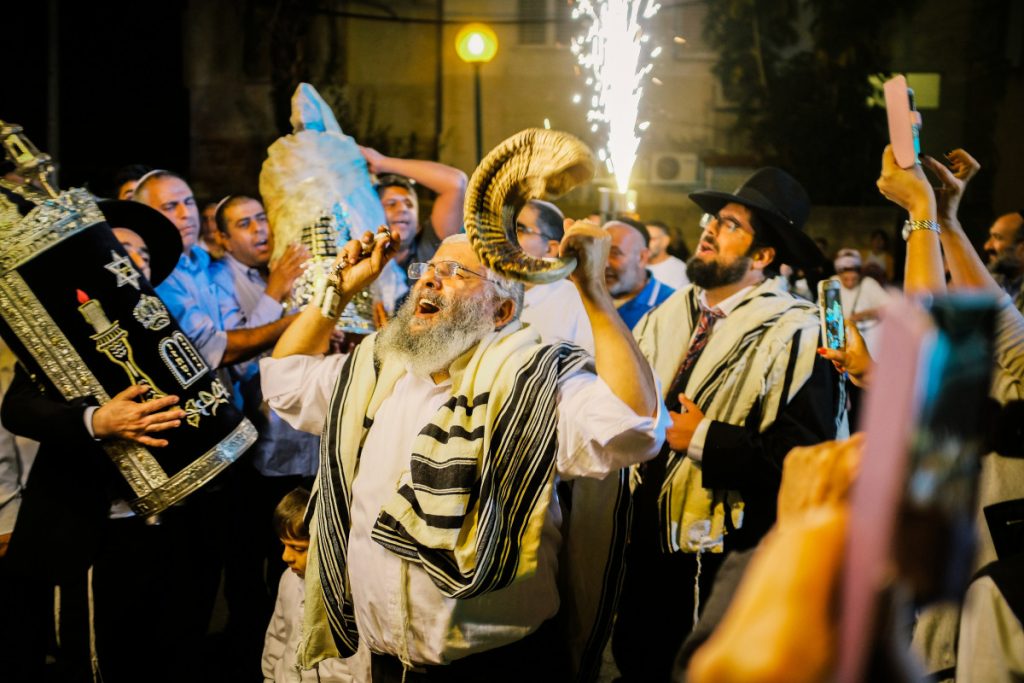
Simchat Torah is dance and song and, in many congregations, a controlled joyful chaos. Torah scrolls are carried aloft; children ride on shoulders and wave flags; the seven hakafot circle the bimah with music and clapping. Every adult present is called for an aliyah to the Torah — sometimes all together beneath a tallit stretched like a wedding canopy. In some communities the celebration spills into the streets outside the synagogue. The last person called for the reading is honored as Chatan Torah (“bridegroom of the Torah”); the person called for the first reading of Genesis is honored as Chatan Bereshit (“bridegroom of Beginning”). Both roles are often given, in progressive congregations, to any member regardless of gender.
Male Perspective
For the queer Jewish men in our brotherhood — and for their allies — Simchat Torah has become one of the most reclaimed and joyful days of the year. The dance is unmistakably embodied. Bodies press together, arms lift, sweat and song and Torah all mixing. In many progressive congregations the Chatan Torah and Chatan Bereshit honors are now called by whatever name and gender fits the honoree, and the wedding-canopy imagery is offered to any adult who wants to stand beneath it with a scroll. The tender queer symbolism — one adult holds up the closing verse, another the opening; the community sings them together — is hard to miss.
Shemini Atzeret asks something different. It asks us to stay one more day. To not rush from the intensity of the fall holy days back into the ordinary week. For men who often live driven, transactional lives, that “one more day” is worth practicing. Yizkor names our beloved dead and lets us stand with them for a slow, honest moment. Then Simchat Torah comes and moves us again.
Summary
Shemini Atzeret and Simchat Torah close the fall festival cycle by refusing a tidy ending. First there is a quiet extra day, and Yizkor. Then there is joyful dance and the Torah scroll carried in circles. Then, at the last, the last verse becomes the first verse and the cycle begins again. The rhythm — stay, remember, dance, begin — has something to teach any circle of men who want to live their spiritual life as an unbroken movement rather than a series of finished chapters.