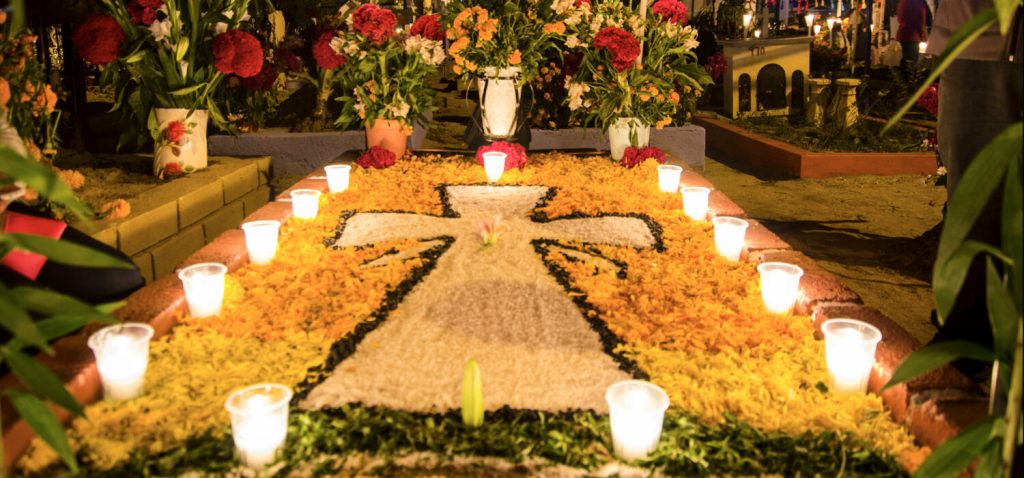
The feast is unusual among Christian observances in that it honors not particular saints but all of them at once — including, and this is the theological heart of the day, the countless saints “known only to God.” Every Christian, in principle, is called to holiness, and the Church has always taught that the roster of canonized saints represents a small public sample of a vast and mostly anonymous crowd. All Saints Day is the day for that crowd.
For a men’s community drawn to embodiment, ancestry, and honest spiritual practice, All Saints is a rare and generous feast. It invites us to remember not only the saints of the official calendar but the saints of our own lives — the men who taught us what to hope for, whose lives showed us that our own were possible, whose absence still shapes us.
History
The earliest traces of All Saints Day go back to the fourth century, when local churches in the Christian East kept a spring feast for all martyrs — a single day to remember the many whose deaths went unrecorded but who had died refusing to renounce Christ. Different regions kept different days: the Syrian Church observed it on the Friday after Easter; other communities kept it in May.
The first Western fixing came in the seventh century. In 609, Pope Boniface IV dedicated the Pantheon in Rome — the great domed temple of Agrippa, then already six centuries old — to the Virgin Mary and to all martyrs. He set the feast on May 13. It was a striking act of Christian conversion: taking the most magnificent surviving temple of pagan Rome and rededicating its emptiness to the anonymous holy dead.
The move to November came in the mid-eighth century. Pope Gregory III dedicated a chapel in Saint Peter’s Basilica to “all the saints” — not only martyrs now, but all who had died in the faith — and set the feast for November 1. The date’s proximity to the Celtic festival of Samhain, celebrated across the newly Christianized regions of Ireland, Britain, and Gaul, was not accidental. Christian missionaries had a long habit of settling their feasts atop older ones, and Samhain — the Celtic day of the ancestral dead — was a natural home for a Christian feast of the holy departed. In 837, Pope Gregory IV extended the November 1 date to the entire Western Church.
By the tenth century, the three days had settled into their permanent order: October 31 as All Hallows’ Even (the eve of All Hallows), November 1 as All Saints (All Hallows) itself, and November 2 as All Souls’ Day. Together they became Allhallowtide, a season for honoring the saints, the souls, and the beloved dead as one unbroken company.
Observances
November 1 is a holy day of obligation for Roman Catholics in most jurisdictions, meaning attendance at Mass is required. The Gospel appointed for the day is Matthew 5:1–12, the Beatitudes — “Blessed are the poor in spirit… Blessed are they that mourn… Blessed are the merciful… Blessed are the pure in heart” — the eight sayings of Jesus that name not the powerful or the righteous, but the humble, the wounded, and the merciful as the true saints of the Kingdom.
Beyond the Mass, observances vary widely across the Christian world. In France, Spain, Italy, and Portugal, cemeteries fill with families cleaning graves, laying flowers (especially chrysanthemums), and lighting candles for the dead. In Mexico and the wider Latin American world, All Saints marks the opening of Día de los Muertos, the two-day observance in which families construct home altars — ofrendas — for their beloved departed. In the Philippines, entire cemeteries become gathering places, with families camping overnight with picnics, music, and prayer at the graves of the dead. In some Nordic Lutheran traditions, families visit graveyards at dusk, and the candles lit at every stone turn the cemeteries into fields of small flames.
For those keeping the feast privately, the traditional practices are simple and portable: light a candle, name a name, read a passage, share a meal in memory. Some communities read the litany of the saints — the sung roll call of the canonized dead — and then add their own names to it: their grandmothers, their teachers, their friends, their beloved lost.
Male Perspective
The Christian tradition has always had gay men in it — as saints, monks, priests, mystics, and martyrs — even when it has not known what to call them. Some are named. Aelred of Rievaulx, the twelfth-century Cistercian abbot, whose On Spiritual Friendship is one of the tenderest queer texts of the Middle Ages. Saint Sebastian, whose martyrdom — bound to a tree, arrows in his young body — became the gay icon it remains today. John Henry Newman, canonized in 2019, whose lifelong friendship with Ambrose St. John was so profound that he asked to be buried in the same grave.
Alongside these are the many holy queer dead who never crossed the Church’s threshold — the ones the community has quietly canonized on its own. Oscar Wilde, destroyed by the state for the crime of loving another man. Alan Turing, whose brilliant mind was broken by the same laws. James Baldwin, whose prophetic writing lit a whole generation. Harvey Milk, shot for showing us it was possible to live openly. And the vast, uncounted crowd — the men who died of AIDS between 1981 and the mid-1990s, when a disease and a silence together took a whole generation of our elder brothers, our lovers, our teachers, our friends. The AIDS quilt is our litany. Every panel is a name spoken.
For many gay men, All Saints Day has quietly become the day to remember these beloved dead — the queer communion, the men who died young, the ones who taught us how to live before we knew we could. Some light a candle. Some read the names aloud. Some visit a grave. Some simply, on this day of all days, allow the memory of the departed to be present at the table.
Summary
All Saints Day is the light that answers Halloween’s dark question. It is the day set aside for remembering that the dead are not lost, that holiness is not the property of the powerful, and that the crowd of the beloved departed presses closer to us than we usually let ourselves feel. For the men of Jonathan’s Circle, November 1 is a natural companion to Halloween — a day to light a candle, name a name, and let ourselves be, for a moment, part of the great long communion of those who have gone before.