History
Columbus Day became a federal holiday in the United States in 1937, largely at the urging of Italian-American civic organizations who saw the observance as recognition of their community’s contributions to American life. For decades it was celebrated with parades, wreath-layings, and school lessons about the 1492 voyage, without much public reflection on what that voyage cost the peoples of the Americas.
That reflection began to surface publicly around the 1977 International Conference on Discrimination Against Indigenous Populations in the Americas, held in Geneva, where Native delegates proposed that Columbus Day be replaced with a day honoring Indigenous peoples. In 1990, the First Continental Encounter of Indigenous Peoples in Quito, Ecuador, extended and formalized that call. Berkeley, California, became the first American city to adopt Indigenous Peoples’ Day in 1992, on the five-hundredth anniversary of Columbus’s voyage. South Dakota adopted its version — Native American Day — statewide the same year.
Momentum was slow through the 1990s and 2000s and then accelerated sharply after 2015. In 2021, President Biden issued the first-ever presidential proclamation of Indigenous Peoples’ Day, observed alongside — not replacing — the still-federal Columbus Day. Many state legislatures have since made the switch official. The day has become an occasion for public acknowledgment of the land on which every American life is lived.
Observances
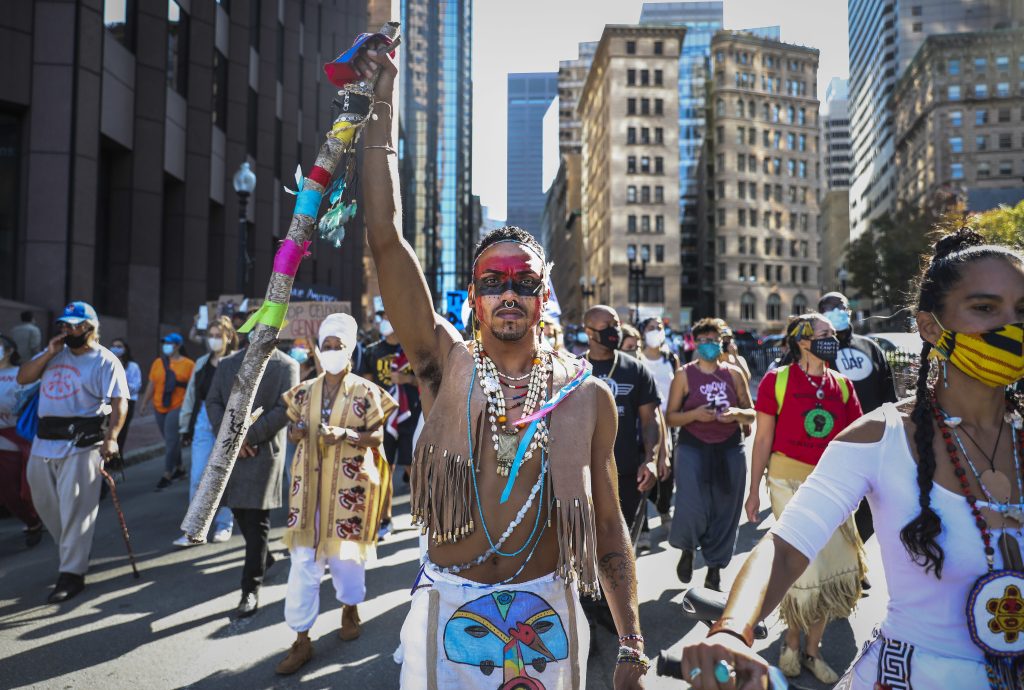
Indigenous Peoples’ Day is marked in cities across the country with powwows, cultural festivals, film screenings, guided walks led by Native elders, and community meals featuring traditional foods. In some cities, statues that once commemorated colonial figures have been reinterpreted or replaced with monuments to Indigenous leaders. Museums and universities host teach-ins on treaty history, boarding-school survival, and contemporary sovereignty movements. Faith communities often include a land acknowledgment in Sunday worship and invite Indigenous voices into the sanctuary.
For non-Native men wanting to observe the day meaningfully, a good starting practice is simply to learn: whose land are you standing on? Which peoples were removed, when, and where do their descendants live today? The website native-land.ca is a widely used entry point. Beyond learning, the day invites concrete acts — donating to a Native-led organization, buying from an Indigenous artisan, following Indigenous writers and thinkers whose work you would not otherwise encounter. It is a day for showing up, not for centering ourselves.
For a men’s spirituality circle, the day is a fitting occasion for a full land acknowledgment at the opening of circle — a considered, specific one rather than a formulaic one — followed by a moment of silence and, if appropriate, by learning together from an Indigenous voice, whether in person, in a book, or through a recorded talk.
Male Perspective
The gay, bisexual, and queer men in our brotherhood carry a particular reason to honor this day. Many Indigenous cultures across the Americas have long recognized what today is often called Two-Spirit identity — a spectrum of genders and roles that does not map neatly onto European binary categories, and that in many traditions carried specific ceremonial responsibilities. Two-Spirit people were healers, keepers of memory, artists, diplomats. They were also, in the centuries after contact, targeted by colonial and missionary systems that could not tolerate their existence. Much was lost. Much has also been reclaimed, especially since the founding of the American Indian Gays and Lesbians organization in 1988 and the Two-Spirit gathering movement that followed.
The queer community owes Indigenous elders and Two-Spirit organizers a debt that is not always acknowledged. Some of our language for gender fluidity, some of our reverence for elders, some of our sense that spirituality and sexuality are inseparable — this has Indigenous roots in North America, however incomplete and non-linear the transmission. Indigenous Peoples’ Day is a good day to sit with that debt and to look up the names of Two-Spirit elders whose work has shaped the world we live in: Barbara Cameron, Randy Burns, Chrystos, Beverly Little Thunder, Ma-Nee Chacaby, and many more.
Summary
Indigenous Peoples’ Day, observed on the second Monday of October, honors the ongoing life of Native peoples in the Americas and asks all of us to reckon honestly with the history of the land we live on. It is a day for learning, for showing up, and — for the men of Jonathan’s Circle — for particularly remembering the Two-Spirit ancestors whose lives helped make our own possible.