
- Walpurgis Night
History
Walpurgis Night, observed on the evening of April 30th, is a European celebration marking the transition from spring to summer with bonfires, dancing, and festivities that blend Christian and pre-Christian traditions. Named for Saint Walburga, an 8th-century English-born Benedictine nun who became abbess of Heidenheim in Germany, the eve of her feast day became associated across Northern and Central Europe with warding off evil spirits, welcoming the fertile season, and lighting fires that echo humanity’s oldest ritual relationship with flame. For men drawn to the wild edges of spiritual practice—where the domesticated meets the untamed—Walpurgis Night offers a threshold between worlds.
Saint Walburga (c. 710-777) was a remarkable woman: educated, multilingual, a healer and writer who traveled from England to Germany as a missionary and became one of the most influential abbesses of her era. Her canonization on May 1st coincided with existing Germanic spring festivals, and the eve of her feast absorbed traditions that had nothing to do with the historical saint—a common pattern in European folk Christianity where pagan celebrations were overlaid with Christian dates rather than eliminated.
In Germanic folklore, Walpurgis Night was believed to be when witches gathered on the Brocken, the highest peak of the Harz Mountains, for a great sabbath—a belief immortalized in Goethe’s Faust, where Mephistopheles leads Faust to the Brocken on Walpurgis Night to witness wild revelry. The association of this night with witchcraft and supernatural activity likely reflects pre-Christian spring fertility rites that the medieval church recast as demonic: the bonfires that once welcomed summer became fires to ward off witches, and the ecstatic dancing that honored the earth’s fertility became evidence of devil worship.
Observances
Bonfires are the central feature of Walpurgis Night celebrations across Northern Europe. In Sweden, Valborg is one of the most widely celebrated nights of the year: massive community bonfires are lit, choral singing welcomes spring, and students in university towns like Uppsala and Lund celebrate with particular enthusiasm, donning white caps and gathering by the thousands along rivers and in parks. In Finland, Vappu (May Day Eve) is celebrated with bonfires, champagne, and the tradition of washing and crowning the Havis Amanda statue in Helsinki.
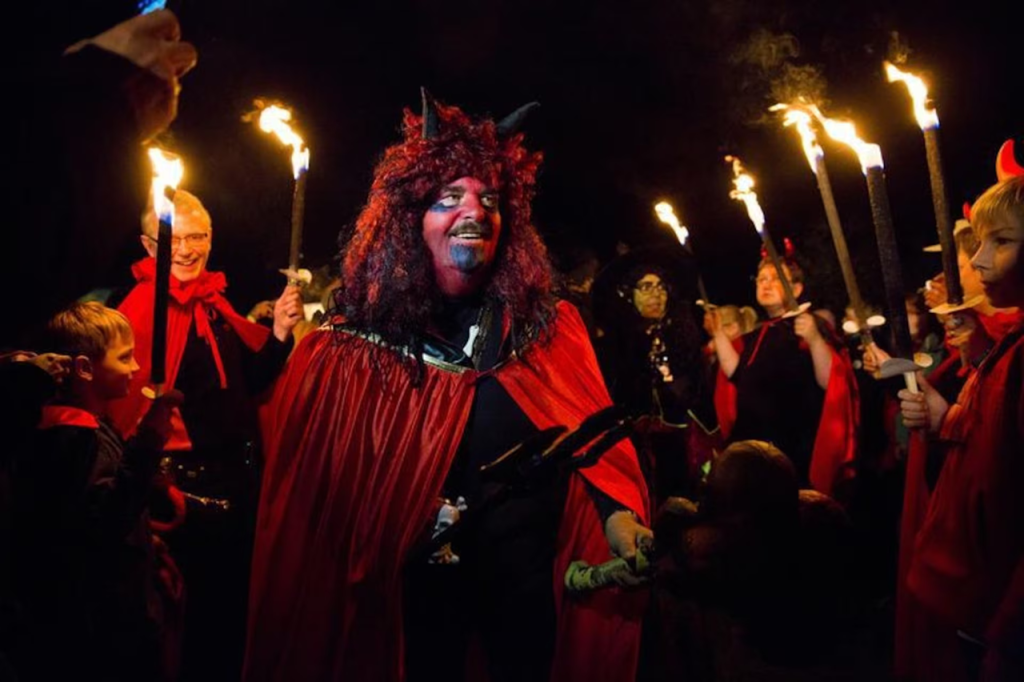
In Germany, particularly in the Harz Mountain region, Walpurgis Night celebrations draw thousands of visitors to towns like Thale and Schierke for costumed festivals where participants dress as witches and devils, dance around bonfires, and reenact the legendary Brocken gathering with theatrical flair. Czech traditions include burning effigies of witches on bonfires and young men leaping over the flames—a test of courage and a fertility rite. Throughout Scandinavia and the Baltic states, the night marks the definitive end of winter’s darkness: after Walpurgis Night, the light has won, and the long bright evenings of northern summer begin. The noise-making traditions—firecrackers, drums, singing, shouting—echo worldwide customs of using sound to drive away evil spirits and welcome beneficial change.
Male Perspective
Fire is perhaps the oldest symbol of masculine spiritual energy: transformative, dangerous, illuminating, and essential. Men have gathered around fires since before recorded history—to cook, to warm, to tell stories, to keep watch through the night. Walpurgis Night’s bonfires connect modern men to this primal inheritance, offering an experience that no screen can replicate: the heat on your face, the sparks rising into darkness, the circle of faces lit by flame, the ancient knowledge that fire changes everything it touches.
The wildness of Walpurgis Night—its association with witches, devils, and ecstatic dancing—represents the return of what civilization suppresses: the untamed, the instinctual, the parts of masculine experience that don’t fit in offices or living rooms. For men who spend their days in controlled environments, performing controlled roles, the invitation to make noise, leap over fire, wear costumes, and dance without self-consciousness is genuinely therapeutic—not as regression but as reconnection with energies that domesticated life atrophies.
The threshold quality of Walpurgis Night—standing between spring and summer, between one season’s death and another’s birth, between the controlled and the wild—mirrors the thresholds men navigate throughout their lives. Every significant passage requires a night of fire: a burning away of what was, an illumination of what is becoming, and the courage to leap. In men’s circles, Walpurgis Night offers an occasion for bonfire gathering, for naming what needs to burn away, for celebrating the wildness that refuses to be entirely civilized, and for welcoming the light that is coming. The man who has never danced around a fire in the dark has missed something essential about being alive.