
- Easter
History
Easter, celebrated on April 5th in 2026, is the most important feast in the Christian liturgical year, commemorating the resurrection of Jesus Christ from the dead on the third day after his crucifixion. Following the intensity of Holy Week—Palm Sunday’s triumph, Holy Thursday’s Last Supper and betrayal, Good Friday’s crucifixion, and Holy Saturday’s descent into death—Easter morning erupts with the proclamation that death has been conquered and new life has broken through. For men who take seriously the mystery of suffering, death, and rebirth, Easter poses the ultimate question: is transformation through death really possible, and what does resurrection look like in a human life?
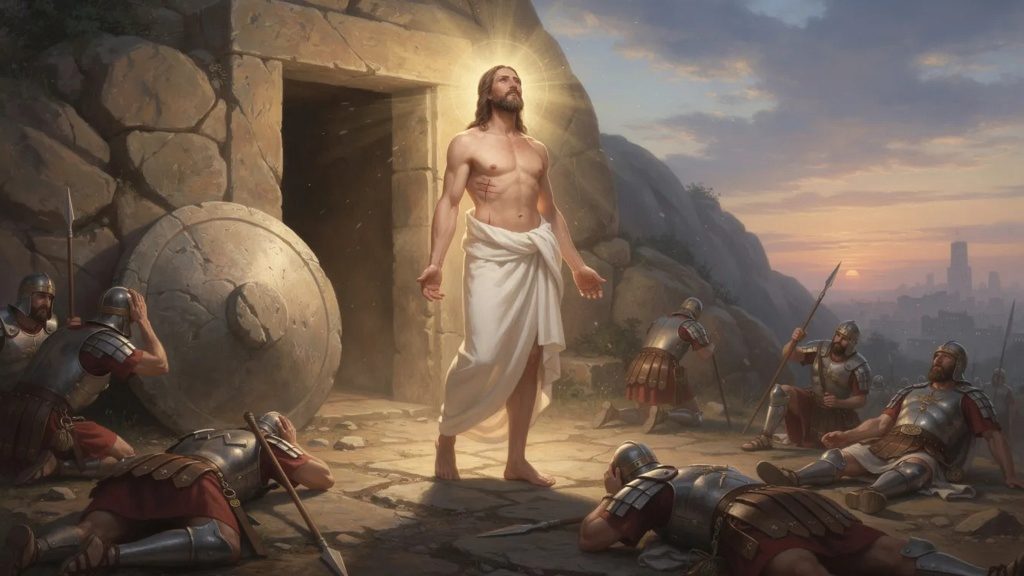
The earliest Christians celebrated Easter as the fulfillment of the Jewish Passover: Christ as the Paschal Lamb whose death liberates humanity from the bondage of sin and death. The date of Easter was the subject of intense early church controversy (the Quartodeciman dispute), eventually settled at the Council of Nicaea (325 CE) as the first Sunday after the first full moon following the spring equinox. The Easter Vigil—the great nighttime liturgy of fire, water, word, and Eucharist—is the oldest and most dramatic Christian worship service, dating to at least the second century.
Easter’s connection to pre-Christian spring celebrations is well-documented: the English name likely derives from Eostre, an Anglo-Saxon goddess of spring and dawn. Eggs, rabbits, and flowers—all symbols of fertility and new life—were incorporated into Easter celebration as Christianity spread through cultures that already marked the spring equinox with renewal festivals. The theological depth of Easter, however, transcends its seasonal setting: this is not merely nature’s annual rebirth but a claim about the fundamental structure of reality—that love is stronger than death, and that the worst thing is never the last thing.
Observances
The Easter Vigil begins in darkness: a new fire is struck, the Paschal candle is lit, and its flame is shared throughout the congregation until the dark church blazes with light—an enactment of creation itself, light emerging from darkness. The Exsultet, the ancient hymn of praise sung over the Paschal candle, proclaims: “This is the night” repeatedly, declaring the present moment as the time of salvation. Baptisms traditionally occur at the Vigil, with catechumens descending into water (symbolic death) and rising to new life, anointed with chrism and clothed in white garments.
Easter morning services range from solemn high liturgies with choirs, brass, and incense to sunrise services held outdoors, greeting the risen Christ with the rising sun. The traditional Easter greeting—”Christ is risen!” answered by “He is risen indeed!”—is exchanged among believers worldwide in hundreds of languages. Easter feasting follows the Lenten fast: lamb (recalling the Paschal sacrifice), eggs (new life emerging from apparent death), hot cross buns, and regional specialties break weeks of abstinence. Easter egg hunts, while seemingly secular, preserve the symbolism of searching for hidden life, discovering what was buried, and the joy of unexpected finding.
Male Perspective
The resurrection narratives place women as the first witnesses—Mary Magdalene and the other women go to the tomb while the male disciples hide in fear behind locked doors. This detail, embarrassing to a patriarchal culture that did not accept women’s testimony, is likely historical precisely because no one would have invented it. For men, the message is bracing: the women had the courage to show up; the men were paralyzed by grief and fear. Easter asks men: where in your life are you hiding behind locked doors when the invitation is to go to the place of death and discover it empty?
The pattern of death and resurrection—dying to an old self and rising to a new one—is the fundamental pattern of masculine spiritual growth. Every significant transition in a man’s life involves a kind of death: the death of adolescence into manhood, the death of a career identity in retirement, the death of a marriage, the death of certainty in the face of doubt, the coming out that kills one life so another can begin. Easter’s claim is that these deaths are not endings but passages, and that what rises is more real, not less, than what was buried.
The physical reality of resurrection matters for men who integrate body and spirit: this is not about the soul escaping the body but about the body itself being transformed and glorified. The risen Christ eats fish, shows his wounds, invites Thomas to touch him—resurrection is embodied, not ethereal. For men in circles that honor the body as sacred, Easter affirms that flesh is not an obstacle to the divine but its chosen dwelling place. The wounds that remain on the risen body suggest that our scars—the marks of what we have suffered and survived—are not erased by transformation but transfigured, becoming sources of healing for others.