
- Holi
History
Holi, the Hindu “Festival of Colors,” is one of the most joyous and visually spectacular celebrations in the world, marking the arrival of spring with explosions of colored powder, bonfires, music, and uninhibited play. Celebrated primarily in India and Nepal but increasingly worldwide, Holi dissolves social boundaries as participants of all castes, classes, and backgrounds drench each other in color, embodying themes of renewal, forgiveness, and the triumph of good over evil. For men exploring the sacred dimensions of embodiment and play, Holi offers powerful teachings about letting go, embracing joy, and allowing the boundaries that usually separate us to dissolve in shared celebration.
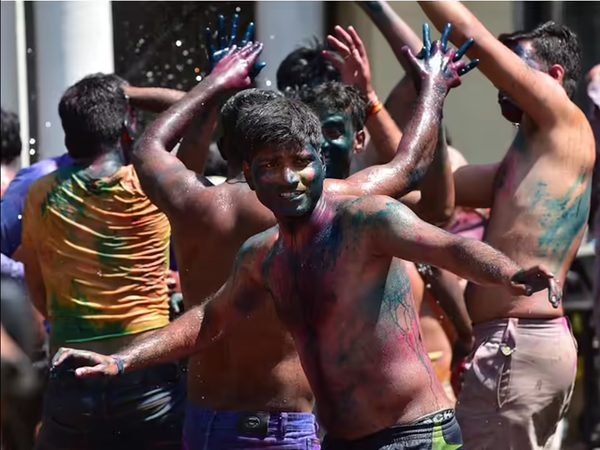
Holi’s origins interweave multiple mythological narratives, most prominently the story of Prahlad and Holika: the demon king Hiranyakashipu, furious that his son Prahlad worshipped Vishnu rather than him, ordered his sister Holika to kill Prahlad by sitting with him in a fire (she was immune to flames); but Prahlad’s devotion protected him while Holika burned, establishing the triumph of devotion over demonic power.
Another origin story celebrates the divine love between Krishna and Radha: according to legend, the young Krishna complained to his mother about his dark skin compared to Radha’s fair complexion, and she playfully suggested he color Radha’s face; this divine play (lila) became the template for Holi’s colorful celebrations.
The festival is timed to the full moon (Purnima) of the Hindu month Phalguna, typically falling in late February or March, marking the transition from winter to spring and celebrating the earth’s renewal. Holi has ancient roots, mentioned in texts dating to the 4th century CE and depicted in temple sculptures and paintings for over a millennium.
Observances
The festival typically spans two days: Holika Dahan (the evening bonfire) and Rangwali Holi (the day of colors). On the eve, communities gather around bonfires symbolizing the burning of Holika and the destruction of evil; people sing, dance, and circumambulate the fire, sometimes roasting grain and coconut as offerings.
The following morning, the color play begins: participants armed with dry colored powders (gulal) and colored water drench each other in brilliant hues—pink, yellow, blue, green, purple—using hands, water guns, and balloons. Social hierarchies dissolve as people of all ages, genders, and social positions play together; the phrase “Bura na mano, Holi hai” (“Don’t be offended, it’s Holi”) gives permission for playful transgression of ordinary social rules.
Music, dancing, and special foods mark the celebration: gujiya (sweet dumplings), thandai (a spiced milk drink sometimes including bhang), and other regional delicacies are shared among families and neighbors. In the afternoon, people wash off the colors, put on clean clothes, and visit friends and family to exchange sweets and seek forgiveness for any offenses—the festival explicitly includes reconciliation as part of celebration.
Regional variations are rich: in Mathura and Vrindavan (associated with Krishna), celebrations last over a week; in Barsana, women playfully beat men with sticks in the Lathmar Holi tradition; in Bengal, Holi coincides with Dol Jatra, featuring processions of Radha and Krishna.
Male Perspective
Holi’s invitation to abandon control, get messy, and play without self-consciousness directly challenges masculine norms of composure, dignity, and emotional restraint—the festival asks men to let themselves be vulnerable, foolish, and joyful without armor.
The Krishna-Radha narrative at Holi’s heart presents eros as play rather than conquest—divine love expressed through color, teasing, and mutual delight rather than domination or possession; this offers men an alternative model of erotic engagement rooted in joy rather than power.
The dissolution of social boundaries during Holi—where the wealthy are colored by the poor, elders by children, bosses by workers—invites men to examine which hierarchies they maintain and what becomes possible when status is temporarily suspended.
The tradition of drinking bhang (cannabis-infused thandai) raises questions about men’s relationship to altered states: when does loosened inhibition open doors, and when does it become escape?
For men conditioned to maintain composure and present a controlled image, Holi’s messiness is medicine: the experience of being covered in color, indistinguishable from everyone else, can dissolve ego boundaries that usually feel solid.
The afternoon tradition of seeking forgiveness reminds men that celebration must be paired with reconciliation—joy is incomplete if relationships remain broken, and the festival creates structured opportunity to repair what has been damaged.
In men’s circles, Holi might be observed through outdoor color play, discussion of themes of divine play and social reversal, and the practice of asking forgiveness from those we’ve harmed—letting the colorful mess outside mirror inner transformation. The erotic dimension of Holi—Krishna pursuing Radha, the mingling of bodies and colors—invites men to consider eros not as conquest but as play, not as taking but as mutual delighting in each other’s presence and beauty.